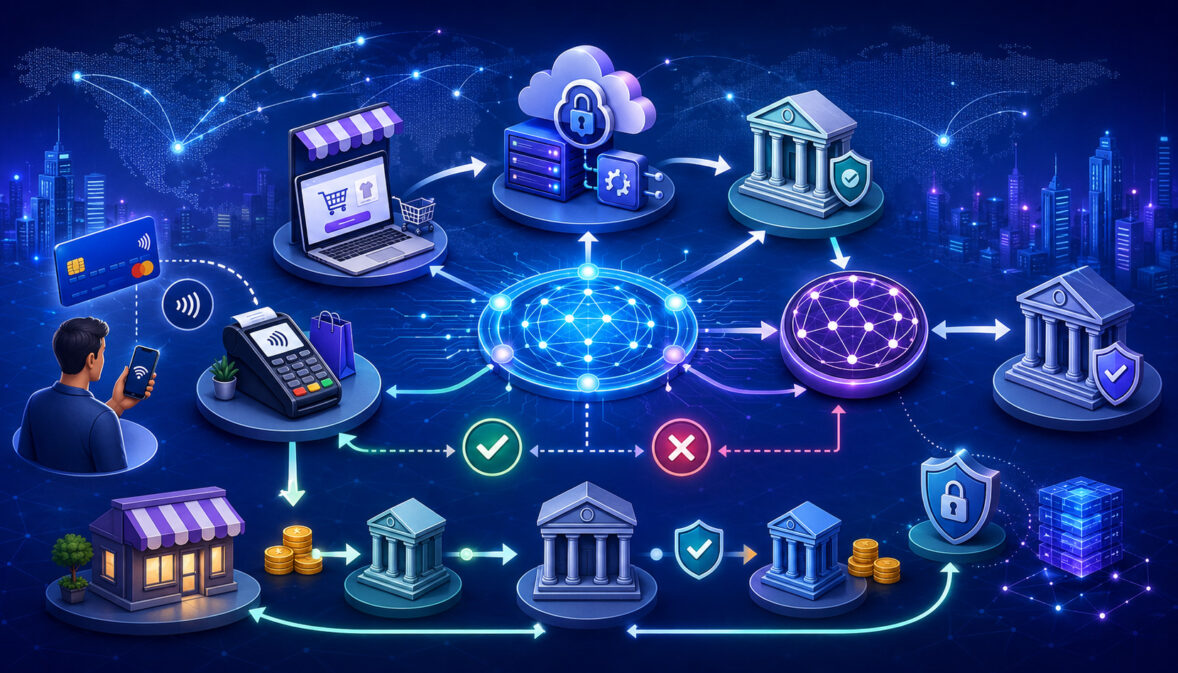
Payment networks are the invisible infrastructure behind most non-cash payments. Every time a customer taps a card, enters payment details at checkout, pays an invoice, uses a digital wallet, schedules a recurring bill, or sends money from one account to another, a network helps move payment instructions between the parties involved.
For business owners, ecommerce sellers, finance teams, startups, and service providers, understanding payment networks is not just a technical exercise. These networks affect approval rates, settlement timing, transaction fees, fraud exposure, refunds, chargebacks, reporting, customer experience, and cash flow.
A payment may feel instant to the customer, but behind the scenes, several connected stages usually happen. The payment must be initiated, secured, routed, authorized, captured, cleared, settled, funded, and reconciled.
Different payment rails handle these steps in different ways, which is why a card payment, ACH transfer, real-time payment, wire transfer, and digital wallet transaction do not all behave the same.
This guide explains payment networks in practical language. It covers who is involved, how payment data and funds move, why authorization is different from settlement, how network fees work, what can go wrong, and how businesses can choose a reliable payment setup.
What Are Payment Networks?
Payment networks are systems that connect customers, businesses, banks, processors, gateways, wallets, and other financial service providers so electronic payments can be sent, approved, cleared, and settled.
They provide the rules, technology, messaging formats, routing logic, security standards, and settlement structure that allow a payment to move from one party to another.
A payment network is not always one single company or platform. It may be a card network, debit card network, ACH network, bank payment network, real-time payment network, wire system, digital wallet ecosystem, or closed-loop payment environment.
Some payment networks support card-present payments at a point of sale. Others support card-not-present payments for ecommerce payments, invoice payments, subscription billing, or account-to-account transfers.
Payment networks generally perform several core functions:
- They move payment messages between parties.
- They help route transactions to the right bank, issuer, account, or payment rail.
- They apply operating rules for approvals, declines, returns, disputes, and settlement.
- They support payment security through encryption, tokenization, authentication, and fraud controls.
- They help determine how and when funds move between financial institutions.
- They create records that businesses use for reporting and reconciliation.
It helps to think of payment networks as the road system for money movement. The road may be a card rail, ACH rail, real-time payment rail, wire rail, or wallet rail. The payment processor, payment gateway, acquiring bank, issuing bank, and other systems act like vehicles, traffic signals, checkpoints, and recordkeepers.
Pro Tip: Do not assume that all digital payment networks move money instantly. A customer may receive an immediate approval message, but merchant funding usually depends on capture, clearing, settlement, risk review, batch timing, and banking rules.
Why Payment Networks Matter for Businesses
Payment networks matter because they influence much more than whether a transaction is accepted. They shape how fast a business gets paid, how much it pays in transaction costs, how easily payments reconcile with sales records, and how well the business can manage fraud, refunds, chargebacks, and customer expectations.
For example, approval rates are partly affected by how complete and accurate the payment data is. A card-not-present transaction with missing billing details may face more fraud scrutiny than an in-person EMV chip transaction.
A recurring billing transaction may need the right stored credential indicators so the issuing bank understands that the customer previously authorized ongoing payments.
Payment network operations also affect costs. Card payment networks may involve interchange fees, assessment fees, network fees, processor markup, payment gateway fees, transaction fees, chargeback fees, and other costs.
ACH network payments often have different fee structures and return rules. A real-time payment network may offer faster confirmation but may also require businesses to think carefully about fraud controls because some transactions are difficult to reverse once completed.
Settlement timing is another important business issue. A sale is not the same as a deposit. An approved card transaction may be captured later, cleared in a batch, settled between financial institutions, and then funded to the merchant account.
Refunds, chargebacks, reserves, risk holds, and settlement adjustments can change the amount that actually reaches the business bank account.
Payment networks also affect customer experience. Customers expect checkout to be fast, secure, and flexible. If a business accepts cards, digital wallet payments, mobile payments, online payment processing, invoice payments, and recurring billing, it can meet more customer preferences.
But each option must be supported by the right payment processing network, gateway, processor, and reporting tools.
Key Participants in Payment Network Operations
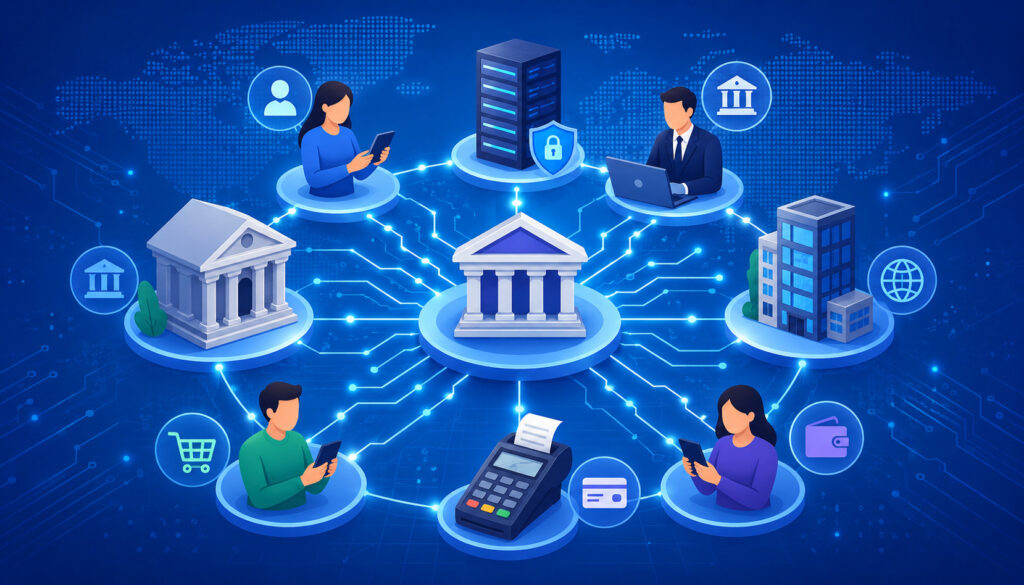
Payment network operations involve multiple participants. The exact parties depend on the payment method, but most electronic payment networks include a customer, a merchant, a payment interface, a processor or gateway, one or more financial institutions, and a payment rail or network.
The customer, also called a cardholder in card transactions, starts the payment. The merchant accepts payment for goods, services, subscriptions, invoices, deposits, or other business activity.
The merchant may accept payment through a POS system, ecommerce checkout, mobile app, virtual terminal, payment link, invoice platform, customer portal, or integrated business software.
A payment gateway securely collects and transmits payment information, especially for ecommerce payments, virtual terminals, hosted checkout pages, and other card-not-present payments.
A payment processor handles transaction communication between the merchant’s payment system, acquiring bank, networks, and issuing banks. An acquiring bank supports the merchant side of card acceptance and may hold or sponsor the merchant account.
An issuing bank provides the customer’s card or account and decides whether to approve or decline many transactions.
A payment facilitator may allow smaller merchants or platform users to accept payments under a sponsored model rather than opening a traditional merchant account directly. Digital wallet providers store payment credentials or tokens and add device-level authentication.
ACH operators and real-time payment rails support bank-to-bank movement. Card networks and debit networks define rules, route messages, and support authorization, clearing, settlement, and disputes for card payments.
For a deeper beginner-friendly explanation of gateway flow, see this overview of how payment gateways work.
Customers, Merchants, and Payment Interfaces
Customers start payments in many ways. They may insert an EMV chip card, tap a contactless card, use a phone-based digital wallet, enter card details online, approve a mobile app purchase, pay an invoice, authorize a bank transfer, enroll in recurring billing, or make a subscription payment.
Each action creates payment data that must be securely captured and sent through the correct channel.
Merchants collect payment details through payment interfaces. In-person businesses often use POS payments, countertop terminals, mobile readers, self-service kiosks, or integrated point-of-sale software.
Ecommerce sellers use checkout pages, shopping carts, hosted payment pages, embedded forms, or payment APIs. Service businesses may use virtual terminals, invoices, payment links, or recurring billing platforms.
The payment interface matters because it affects data quality and risk. Card-present payments often include chip or contactless data that can help authenticate the transaction.
Card-not-present payments rely more heavily on billing address checks, card security codes, device signals, customer behavior, and fraud screening. Recurring payments require stored credential handling and clear customer authorization.
A good interface also improves reconciliation. When the checkout, invoice, POS, or software system passes order numbers, customer identifiers, tax, tip, shipping, and invoice details into the payment record, the finance team can match deposits to sales more easily.
Processors, Banks, Networks, and Payment Rails
After the customer starts the payment, the transaction usually moves through a processor, bank, network, or rail. These parties help route messages, verify details, apply operating rules, and support funds movement.
The payment processor connects the merchant’s payment environment to the broader payment processing network. The processor may send card authorization requests to an acquiring bank, route debit transactions to available debit networks, format ACH entries, communicate with a real-time payment network, or provide reporting and settlement files.
The acquiring bank supports the merchant side of the transaction. The issuing bank or receiving financial institution supports the customer side. In card transactions, the issuing bank reviews the transaction and decides whether to approve it.
In ACH and bank transfer transactions, financial institutions exchange account-based instructions and may later handle returns if account details are invalid, funds are unavailable, or authorization is disputed.
Payment rails are the systems that carry payment messages and value. Card rails, ACH rails, real-time payment rails, wire rails, digital wallet rails, and closed-loop rails each have different rules, settlement timing, cost profiles, and risk considerations.
How Payment Networks Operate Step by Step
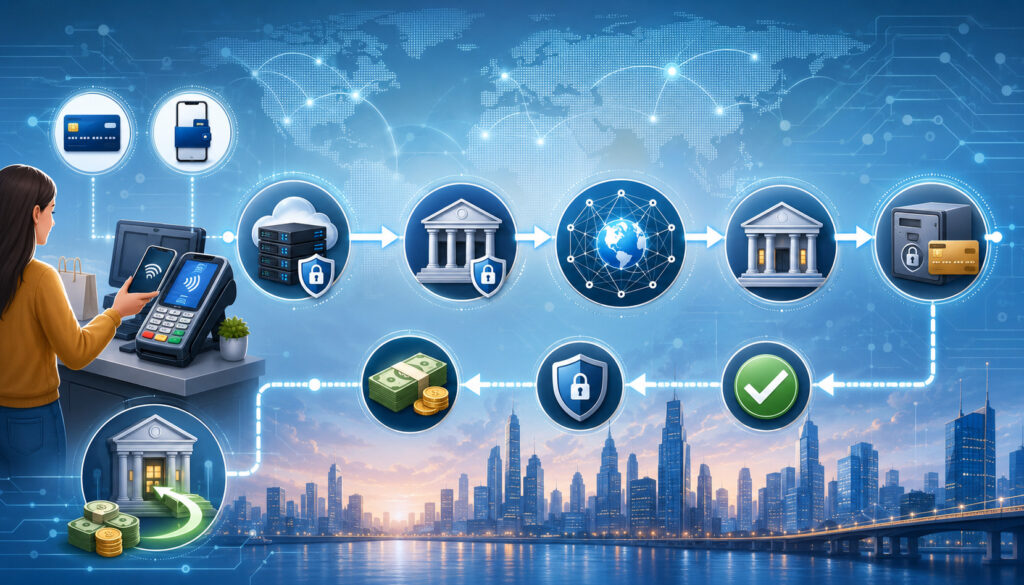
Payment networks operate through connected stages. The exact sequence depends on the payment method, but the practical flow is usually payment initiation, authentication and security checks, transaction routing, payment authorization, capture, payment clearing, payment settlement, merchant funding, and post-transaction activity.
First, the customer initiates the payment. This may happen at a terminal, on a website, inside an app, through an invoice, or through a bank transfer authorization. The merchant’s system collects the payment details and sends them securely to the payment gateway, payment processor, or integrated payment software.
Next, security checks begin. The system may encrypt payment data, tokenize sensitive credentials, check device signals, validate card security data, compare billing details, and apply fraud screening rules. The goal is to confirm that the transaction appears legitimate without adding unnecessary friction for good customers.
Then the transaction is routed. Transaction routing determines which network, bank, processor, debit network, ACH operator, or real-time payment rail receives the message. Routing can affect cost, approval probability, speed, and reliability.
Authorization comes next. For card payments, the issuing bank reviews available credit or funds, account status, merchant category, fraud indicators, security data, and transaction amount. For bank payment networks, the receiving or sending institution may validate account and transaction rules depending on the rail.
After approval, the transaction may need capture. Captured transactions are prepared for clearing and settlement. Clearing organizes transaction records, calculates fees, and creates instructions between financial institutions.
Settlement moves funds between institutions. Merchant funding occurs when the business receives the net proceeds, usually after fees, refunds, reserves, chargebacks, or adjustments.
Step 1: Payment Initiation
Payment initiation begins when a customer chooses a payment method and gives permission for a transaction to start. In a retail setting, this may happen when the customer inserts a chip card, taps a contactless card, swipes a fallback card, or uses a mobile wallet at the terminal.
For ecommerce payments, initiation begins when the customer enters payment details or selects a saved payment method at checkout.
For invoice payments, the customer may click a payment link and enter card or bank account information. For recurring billing, the customer may authorize the merchant to charge a stored payment method on a schedule.
For subscription payments, the first payment often includes customer authentication, while later payments may use stored credentials and recurring indicators.
Payment initiation also includes bank transfers. A customer may authorize an ACH debit, approve an account-to-account payment, or send funds through a bank payment network. In these cases, the payment data may include bank account information, routing details, authorization language, payment amount, and effective date.
The payment method determines the first set of rules. EMV chip payments create dynamic transaction data that helps reduce counterfeit card risk. Contactless transactions may use secure tokenized credentials.
Digital wallet payments may involve device authentication before payment data is passed into the network. Card-not-present payments rely more on entered data, fraud signals, and risk tools.
Good payment initiation depends on clarity. Customers should see the amount, billing terms, refund policy, subscription timing, and payment method before they approve. Clear initiation reduces disputes later.
Step 2: Authentication and Security Checks
Authentication and security checks help payment networks determine whether a transaction appears legitimate. These checks protect customers, merchants, banks, processors, and the broader payment system.
For card-present payments, EMV chip data helps prove that the card is present and difficult to counterfeit. Contactless payments also use secure transaction data. For digital wallet payments, the wallet may rely on device-level authentication such as a passcode, biometric approval, or secure device credentials before a tokenized payment credential is used.
For ecommerce and card-not-present payments, security checks may include CVV validation, AVS, device recognition, IP review, velocity checks, fraud scoring, email or phone risk signals, and purchase pattern analysis.
AVS compares billing address details with information available to the issuing bank. CVV helps confirm that the buyer has access to the card security code, although it does not guarantee that the transaction is legitimate.
Encryption protects payment data while it moves through systems. Tokenization replaces sensitive card or account details with a substitute value that is less useful if exposed. Secure APIs help systems exchange payment messages safely.
PCI compliance helps businesses handle cardholder data under recognized security requirements. The official payment security standards resource is useful for understanding card data protection expectations.
Security tools should be balanced. Too little screening can increase fraud and chargebacks. Too much friction can block legitimate customers. Businesses should review fraud rules, decline patterns, and manual review queues regularly.
Step 3: Transaction Routing Through the Network
Transaction routing is the process of sending payment data through the correct network, processor, bank, or rail. It is one of the most important parts of payment network operations because routing can affect approval rates, cost, speed, and reliability.
For card payments, the payment gateway or POS system sends payment data to the payment processor. The processor may route the transaction through an acquiring bank and then to the appropriate card network, debit card network, or credit card network.
The network identifies the issuing bank and forwards the authorization request. The response then travels back through the same general chain to the merchant.
For debit card transactions, routing may involve choices among available debit networks, depending on transaction type, merchant configuration, card capabilities, and regulatory requirements. Routing decisions can influence network fees and transaction economics.
For ACH payments, transaction routing uses bank account and routing information to move entries between originating and receiving financial institutions through ACH operators. The ACH payments fact sheet is a helpful resource for understanding the network’s role in electronic bank account payments.
For real-time payment networks, routing is designed for rapid account-to-account messaging and confirmation. These payments can support faster availability, but businesses must understand finality, fraud controls, and operational readiness.
Step 4: Authorization and Approval
Payment authorization is the stage where the relevant financial institution decides whether a transaction should be approved or declined. In card payment networks, the issuing bank usually makes this decision. In bank payment networks, authorization and validation depend on the rail, transaction type, and financial institution rules.
For card transactions, the authorization request includes details such as transaction amount, merchant category, card data or token data, security indicators, entry mode, currency, location, and sometimes address or device information. The issuing bank checks the account status, available funds or credit, risk signals, card restrictions, fraud patterns, and network rules.
The issuing bank may approve the transaction, decline it, or request additional authentication where supported. An approval usually places a hold on the cardholder’s available balance or credit line.
A decline may happen because of insufficient funds, expired card details, suspected fraud, incorrect security data, issuer restrictions, account closure, or technical issues.
Authorization does not always equal final payment. For some businesses, the authorized amount may be captured later. A hotel, rental service, restaurant, fuel station, or service provider may authorize one amount and capture another final amount within allowed rules. Ecommerce sellers may authorize at checkout and capture when goods ship.
Authorization quality depends on accurate data. Complete billing information, proper transaction indicators, correct merchant category setup, and secure acceptance methods can improve the chance that legitimate transactions are approved.
Step 5: Capture, Clearing, and Settlement
After payment authorization, the merchant usually needs to capture the transaction. Capture tells the payment processor that the approved transaction should be included for clearing and settlement. Some systems capture automatically at the time of sale, while others allow delayed capture.
Payment clearing is the process of exchanging final transaction records between financial institutions and networks. Clearing records contain information needed to calculate fees, confirm transaction details, allocate funds, and create settlement obligations.
In card payment networks, clearing may include interchange fees, assessment fees, network fees, transaction identifiers, authorization references, and merchant details.
Payment settlement is the movement of funds between financial institutions. Settlement does not always happen at the same moment the customer receives an approval message. Many card transactions are settled after batch submission.
ACH transactions are often processed in batches and may have return windows. Real-time payment networks are designed for faster confirmation and settlement behavior, but business availability still depends on bank and provider setup.
Settlement files are important for business operations. They help finance teams match payments to orders, fees, refunds, chargebacks, tips, taxes, shipping, and deposits. If batch records are incomplete or inconsistent, reconciliation becomes harder.
Businesses should understand their settlement cut-off times. A transaction captured after the cutoff may be included in the next settlement cycle, which can delay merchant funding.
Step 6: Merchant Funding and Reconciliation
Merchant funding is the stage where the business receives money in its merchant account or business bank account. The deposit may be gross or net depending on the processing arrangement.
Many businesses receive net deposits, meaning processing fees, refunds, chargebacks, reserves, or adjustments may already be deducted.
Funding timing depends on payment method, processor policies, acquiring bank rules, risk review, batch timing, weekends, banking holidays, settlement status, and the merchant’s account history.
Some businesses may qualify for faster funding. Others may experience funding holds if there are unusual sales spikes, high chargeback rates, suspicious transactions, large ticket changes, or missing documentation.
Reconciliation is the process of matching payment activity to sales records, invoices, deposits, refunds, chargebacks, and fees. Strong reconciliation helps businesses understand cash flow and identify errors quickly.
A business should review:
- Daily batch reports
- Gateway transaction reports
- Processor statements
- Deposit records
- Refund activity
- Chargeback notices
- ACH returns
- Reserve activity
- Fee summaries
Reconciliation problems often happen when sales systems, gateways, processors, and accounting platforms use different transaction identifiers. Passing invoice numbers, order IDs, customer IDs, and batch IDs through the payment process can reduce confusion.
Payment Network Operations Table
The following table summarizes the major stages of payment network operations in a practical way.
| Network Stage | What Happens | Main Parties Involved | Why It Matters |
| Payment initiation | Customer starts a payment through a card, wallet, bank transfer, invoice, app, or checkout | Customer, merchant, POS system, ecommerce platform, invoice tool | Sets the transaction type, data quality, and customer experience |
| Authentication and security | Systems check payment credentials, device signals, CVV, AVS, EMV data, tokens, and fraud rules | Customer, gateway, processor, wallet provider, fraud tools | Helps reduce unauthorized transactions and payment risk |
| Transaction routing | Payment data is sent through the correct payment network, processor, bank, or rail | Gateway, processor, acquiring bank, card network, ACH network, real-time payment network | Affects approval, speed, cost, and reliability |
| Payment authorization | Issuing bank or financial institution approves or declines the transaction | Issuing bank, receiving bank, processor, network | Determines whether the payment can proceed |
| Capture | Approved transaction is submitted for completion | Merchant, gateway, processor, acquiring bank | Moves the transaction toward clearing and settlement |
| Payment clearing | Final records are exchanged and fees are calculated | Networks, processors, banks, operators | Creates official records for settlement and reporting |
| Payment settlement | Funds move between financial institutions | Acquiring bank, issuing bank, ACH operator, bank payment network | Determines when value moves through the system |
| Merchant funding | Business receives deposit, usually net of fees or adjustments | Processor, acquiring bank, merchant account provider, business bank | Affects cash flow and operating capital |
| Post-transaction activity | Refunds, chargebacks, returns, disputes, reporting, and reconciliation occur | Merchant, customer, banks, processor, network | Supports customer service, compliance, and financial accuracy |
Different Types of Payment Networks
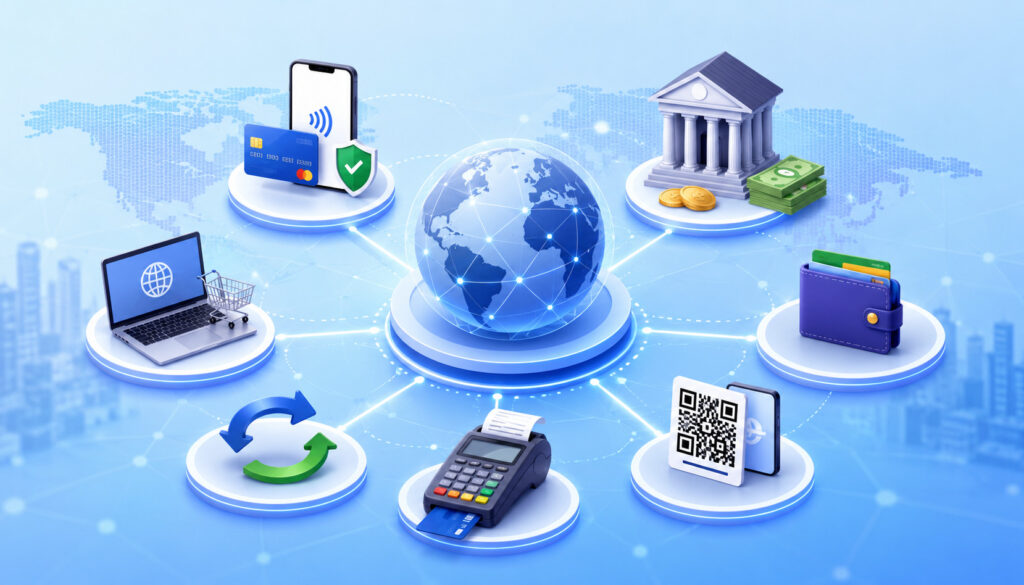
Payment networks are not all built for the same purpose. Some are optimized for card acceptance at checkout. Some move funds between bank accounts. Some provide faster confirmation.
Some support high-value transfers. Others operate inside a closed ecosystem where the same platform manages customer accounts, merchant acceptance, and internal balances.
Card payment networks support credit card, debit card, prepaid card, mobile wallet, online payment processing, card-present payments, and card-not-present payments. They are widely used for retail, ecommerce, subscriptions, travel, restaurants, services, and many other payment environments.
ACH networks support account-to-account transfers, direct deposits, recurring billing, bill payments, vendor payments, payroll-style payments, and many business payment processing use cases. They are often useful when speed is less important than cost efficiency or recurring account-based collection.
Real-time payment networks support faster account-to-account transfers and payment confirmation. They can be useful for urgent payouts, instant bill payments, just-in-time supplier payments, insurance disbursements, and other time-sensitive transactions.
Wire systems are often used for larger or time-sensitive bank transfers. Digital wallet ecosystems may sit on top of card rails, bank rails, stored balances, or tokenized credentials. Closed-loop networks process payments within a limited environment, such as a specific marketplace, retailer, campus, transit system, or stored-value program.
Each network has tradeoffs. Businesses should compare speed, cost, reversibility, fraud risk, customer preference, reporting, integration effort, and settlement expectations.
Card Payment Networks
Card payment networks connect merchants, acquiring banks, processors, issuing banks, and cardholders so card transactions can be authorized, cleared, settled, refunded, and disputed.
These networks support credit card network and debit card network transactions, including card-present payments, card-not-present payments, mobile payments, digital wallet payments, recurring billing, ecommerce payments, and POS payments.
Card networks define rules for transaction messaging, acceptance standards, dispute handling, interchange categories, security expectations, authorization formats, clearing records, and settlement processes.
They help make it possible for a card issued by one financial institution to be accepted by many different merchants through many different processors and acquirers.
In a typical card transaction, the merchant submits payment data through a terminal, gateway, or software system. The processor routes the authorization request through the acquiring side and the card network to the issuing bank. The issuing bank approves or declines. Later, the transaction is captured, cleared, settled, and funded to the merchant.
Card rails are convenient and familiar, but they involve layered costs. Interchange fees, assessment fees, network fees, processor markup, gateway fees, and chargeback costs can all affect the total cost of acceptance.
Bank Transfer and Account-to-Account Networks
Bank transfer and account-to-account payment networks move money directly between deposit accounts. These networks are often used for payroll-style payments, bill payments, vendor payments, recurring payments, rent, tuition, insurance payments, membership dues, and business-to-business transfers.
ACH network transactions are common account-to-account payments. They can support credits, where money is pushed to a receiver, and debits, where a business pulls funds after receiving authorization.
ACH payments are useful for recurring billing and larger invoices because fees may be lower than card fees, but settlement timing, return risk, account validation, and authorization records require careful management.
Account-to-account networks often rely on routing numbers, account numbers, bank identifiers, authorization language, transaction codes, and settlement windows. A transaction may appear successful at submission but later return due to insufficient funds, closed accounts, incorrect account details, unauthorized claims, or other return reasons.
Businesses using account-to-account payments should validate account information where possible, keep authorization records, communicate payment timing clearly, and monitor returns. These practices reduce failed payments and customer confusion.
Card Payment Network Operations
Card payment network operations begin when a cardholder presents card credentials to a merchant. The cardholder may use a physical card, a digital wallet token, a stored card, or manually entered card details. The merchant’s POS system, ecommerce platform, mobile reader, virtual terminal, or payment gateway collects the payment information.
The transaction is sent to the payment processor, which formats and routes the request. The acquiring bank or acquiring processor sends the request through the appropriate card network.
The card network identifies the issuing bank and passes the request along. The issuing bank checks the cardholder’s account, available credit or funds, fraud signals, merchant category, transaction amount, entry method, and security data.
The issuing bank returns an authorization response. If approved, the merchant can complete the sale. If declined, the merchant receives a decline response. The customer may use another payment method, correct information, or contact the issuer.
After approval, the merchant captures the transaction. Captured transactions are sent for clearing, where final transaction data is exchanged and fees are calculated. Settlement then moves funds between the issuing and acquiring sides. The merchant receives funding according to the processor’s funding schedule and merchant account arrangement.
Refunds and chargebacks are also part of card payment network operations. A refund is usually initiated by the merchant to return money to the customer.
A chargeback is initiated through the cardholder’s issuing bank when the cardholder disputes a transaction. Network rules define dispute reason codes, response timelines, evidence requirements, and financial liability.
For a broader explanation of the basic ecosystem, this article on how payment processing works provides useful background.
ACH and Bank Payment Network Operations
ACH and bank payment network operations use account-based instructions rather than card credentials. A business may originate an ACH debit to collect payment from a customer’s bank account, or an ACH credit to send funds to a vendor, employee, contractor, or customer.
The business or platform that starts the ACH entry is often called the originator. The financial institution that sends the entry into the network is the originating financial institution.
The financial institution that receives the entry is the receiving financial institution. ACH operators help exchange entries between financial institutions and support settlement according to network rules.
ACH payments are commonly processed in batches. This means transactions may be collected, submitted, processed, and settled according to scheduled windows rather than individually in real time. Same-day options may be available for eligible entries, but timing still depends on submission windows, financial institution support, risk controls, and posting practices.
ACH returns are a major operational consideration. A transaction may return because the account is closed, funds are unavailable, account details are incorrect, authorization is disputed, or the transaction does not meet network rules. Because returns can happen after submission, businesses should not treat every ACH transaction as final immediately.
Account validation can reduce failed payments. Businesses may use validation tools, micro-deposit verification, secure bank login verification, or other account confirmation methods depending on their payment setup. Clear authorization language, customer notices, and accurate records are also important.
Real-Time Payment Network Operations
A real-time payment network is designed to move account-to-account payment messages quickly, often with immediate confirmation. Unlike batch-based systems, real-time payment rails are built for continuous availability and rapid communication between participating financial institutions.
In a typical real-time payment, the sender initiates a credit push. This means the sender authorizes funds to move from their account to the receiver, rather than giving the receiver permission to pull funds later.
The payment message is routed through the real-time payment network to the receiving financial institution. The receiving institution confirms whether the account can receive the payment, and confirmation travels back through the network.
Real-time payment networks can be useful for urgent vendor payments, emergency disbursements, insurance payouts, marketplace seller payouts, payroll corrections, loan disbursements, and customer refunds where faster availability is valuable. They can also improve communication because payment confirmation is usually part of the process.
However, faster payments require stronger operational discipline. Some real-time payments may be difficult to reverse once sent. Businesses need controls for account verification, approval workflows, fraud screening, payment limits, user permissions, and exception handling. Speed should not replace review for high-risk payments.
Real-time payment networks are not automatically the best option for every transaction. Businesses should compare cost, customer adoption, bank participation, payment finality, fraud exposure, reporting, and integration effort before relying on them for core payment flows.
Digital Wallets and Payment Network Operations
Digital wallet payments allow customers to pay using stored credentials, tokenized card information, device authentication, or wallet balances. They can support in-person contactless payments, in-app payments, ecommerce payments, and mobile payments.
A key feature of many digital wallet payments is tokenization. Instead of passing the actual card number to the merchant, the wallet may use a payment token. The token represents the underlying payment credential but is limited in how it can be used. This reduces the exposure of sensitive card data and can improve payment security.
Digital wallets may also authenticate the customer through a device passcode, biometric approval, secure hardware, or account login. When the customer approves the transaction, the wallet sends tokenized payment data through the merchant’s terminal, app, or checkout flow.
From there, the transaction may still move through card payment networks, bank payment networks, or other digital payment rails depending on the wallet and funding source.
Merchants may not receive the actual card number in many wallet transactions. Instead, they receive tokenized data and transaction identifiers. This can affect customer lookup, recurring billing, refunds, and reconciliation if systems are not configured properly.
Digital wallet payments can improve checkout speed and reduce manual entry errors. They can also help conversion in ecommerce payments because customers do not need to type card details. Businesses should still monitor wallet-specific declines, refund behavior, chargeback handling, and reporting fields.
Payment Rails Explained in Simple Terms
Payment rails are the pathways that payment data and funds use to move between parties. The phrase is similar to railroad tracks: different rails go to different destinations, move at different speeds, follow different rules, and carry different kinds of traffic.
Card rails are built for card-based purchases. They are common at retail checkout, online checkout, mobile payments, and recurring billing. They support fast authorization and broad customer familiarity, but they may involve higher transaction costs and chargeback exposure.
ACH rails are bank account rails. They are often used for recurring payments, bill payments, vendor payments, payroll-style transfers, and business payment processing. They may cost less than card payments, but settlement may take longer and returns can occur after submission.
Real-time payment rails support faster account-to-account movement and confirmation. They are useful when speed matters, but businesses should consider fraud prevention and finality.
Wire rails are typically used for larger, urgent, or formal bank transfers. They may be more expensive and operationally manual than other options, but they are useful in certain high-value scenarios.
Digital wallet rails may connect to card rails, bank rails, stored balances, or tokenized credentials. Closed-loop rails operate inside a controlled environment, such as a marketplace, private account system, or stored-value program.
A good payment setup often uses more than one rail. For example, a business might use card rails for checkout, ACH rails for recurring invoices, real-time rails for urgent payouts, and wallet payments for mobile convenience.
Payment Network Comparison Table
| Payment Network Type | Common Use Cases | Typical Speed | Key Business Considerations |
| Card payment networks | Retail checkout, ecommerce, subscriptions, mobile wallets, service payments | Fast authorization; funding depends on capture and settlement | Broad acceptance, layered fees, chargebacks, PCI compliance |
| Debit card networks | POS payments, card-present purchases, certain PIN or signature debit transactions | Fast authorization; settlement varies by setup | Routing, cost, cardholder funds availability, network rules |
| ACH network | Recurring billing, vendor payments, bill payments, account-to-account transfers | Batch-based; timing depends on submission and settlement windows | Lower cost potential, returns, authorization records, account validation |
| Real-time payment network | Urgent payouts, instant account transfers, emergency payments, time-sensitive business payments | Rapid messaging and confirmation | Fraud controls, finality, bank participation, limits |
| Wire systems | High-value transfers, urgent bank payments, formal business transfers | Often same-day depending on cutoff and bank process | Higher cost, operational controls, strong approval workflows |
| Digital wallet ecosystems | Contactless payments, in-app payments, online checkout, mobile payments | Often fast at checkout; settlement depends on underlying rail | Tokenization, customer convenience, wallet reporting |
| Closed-loop networks | Marketplaces, stored value, private ecosystems, campus or loyalty payments | Depends on platform rules | Limited acceptance, internal rules, balance management |
How Payment Networks Make Money
Payment networks and the providers connected to them earn money through different fee layers. These costs vary by payment method, transaction type, risk level, business category, sales channel, and provider pricing model. Businesses should avoid assuming that one published rate tells the whole story.
For card payments, interchange fees are usually a major cost component. Interchange is typically paid to the issuing bank and varies based on factors such as card type, transaction method, merchant category, data quality, and risk profile.
Assessment fees and network fees are paid in connection with card network operations. Processor markup, gateway fees, monthly fees, PCI-related fees, chargeback fees, and transaction fees may also apply.
This interchange fee explanation offers a useful overview of how interchange fits into card acceptance costs.
ACH payments may involve per-transaction fees, monthly platform fees, return fees, account validation fees, and same-day processing fees where available. Real-time payment networks may involve transaction fees, platform fees, bank service fees, or integration costs. Wire transfers often carry higher per-transfer fees.
Chargebacks, refunds, and returns can add indirect costs. A refund may return the customer’s money but not always reverse every fee. A chargeback may include a dispute fee, lost merchandise, operational time, and additional risk review. ACH returns may create administrative cost and delay expected cash flow.
Payment Network Rules and Compliance
Payment networks rely on rules because trust is essential. Without shared rules, merchants, customers, banks, processors, and networks would not know how to handle authorization, clearing, settlement, disputes, refunds, returns, security, data formatting, or liability.
Card network rules may cover acceptance practices, authorization requirements, recurring billing, stored credentials, dispute timelines, refund handling, surcharge rules, merchant category coding, settlement procedures, and data security obligations.
Debit networks may have additional routing and authentication rules. ACH network rules cover authorization, entry formatting, return codes, settlement timing, account types, and responsibilities of originating and receiving institutions.
PCI compliance is an important part of card payment security. Businesses that store, process, or transmit cardholder data must understand their responsibilities.
Using a secure payment gateway, hosted checkout, tokenization, and validated payment tools can reduce exposure, but it does not remove all responsibility. Businesses should review the official PCI resources and work with qualified providers when needed.
This guide to avoiding PCI non-compliance issues can help business readers understand why secure handling matters.
Compliance also includes operational discipline. Businesses should maintain written refund policies, preserve transaction records, secure staff access, update POS systems, review user permissions, monitor suspicious activity, and train employees on payment procedures.
Security in Payment Network Operations
Payment security protects sensitive data, reduces fraud, and helps maintain trust in electronic payment networks. Security works best when it is layered. No single tool prevents every problem.
Encryption protects payment data during transmission by making it unreadable to unauthorized parties. Tokenization replaces sensitive payment credentials with substitute values.
EMV chip technology helps reduce counterfeit card fraud in card-present environments. Digital wallet tokens help prevent merchants from receiving actual card numbers in many wallet transactions.
Fraud screening evaluates risk signals. These may include transaction amount, billing address, shipping address, device fingerprint, IP location, purchase frequency, failed attempts, card testing patterns, customer account age, and behavior compared with prior transactions.
AVS and CVV checks are common for card-not-present payments, but they should be used as part of a broader risk strategy.
Secure payment gateways and payment processors help transmit transaction data safely. Businesses can learn more from this payment gateway overview, especially when comparing hosted checkout, API integrations, and secure data handling options.
Security also depends on people and processes. Staff should know how to spot suspicious orders, avoid writing down card numbers, protect login credentials, and follow refund procedures. Administrators should use strong access controls, multi-factor authentication, role-based permissions, and regular software updates.
Chargebacks, Refunds, Returns, and Disputes
Post-transaction activity is a major part of payment network operations. Payments do not end at approval or settlement. Customers may request refunds, banks may return ACH payments, cardholders may dispute transactions, processors may adjust settlements, or businesses may need to reverse duplicate charges.
A refund is usually initiated by the merchant. It sends money back to the customer through the same or related payment path. Refund timing depends on the payment method, processor, issuing bank, and network rules. A void or authorization reversal may be used when a transaction has been authorized but not fully captured or settled.
A chargeback is different. It is usually initiated by the cardholder through the issuing bank. The issuing bank sends the dispute through the card network to the acquiring side. The merchant may be asked to provide evidence, such as receipts, delivery confirmation, customer communication, refund policy, service records, or proof of authorization.
ACH returns are also different from card chargebacks. ACH entries can return for reasons such as insufficient funds, closed accounts, invalid account details, or unauthorized claims. Businesses using ACH should understand return codes and keep authorization records.
This overview of payment reversals, refunds, and chargebacks provides additional context on how reversals affect merchants.
Clear policies reduce disputes. Businesses should make billing descriptors recognizable, provide receipts, respond quickly to customer issues, publish refund terms, and avoid surprise subscription renewals.
What Can Go Wrong in Payment Network Operations?
Payment networks are reliable, but problems still happen. A transaction can fail during initiation, security screening, routing, authorization, capture, clearing, settlement, funding, or reconciliation. The cause may be customer-related, merchant-related, network-related, bank-related, or technical.
Common problems include declined transactions, incorrect payment details, expired cards, insufficient funds, fraud flags, duplicate charges, gateway outages, processor downtime, routing failures, batch errors, ACH returns, refund delays, settlement delays, funding holds, chargebacks, reporting mismatches, and reconciliation gaps.
Some issues are visible immediately. A customer may see a decline at checkout. Other issues appear later. A merchant may see an ACH return days after believing a payment was successful. A deposit may be lower than expected because fees, refunds, or chargebacks were deducted. A batch may fail to settle because the terminal was not closed properly.
The key is to identify patterns. One failed transaction may be a customer issue. Repeated failures with the same payment method, gateway, terminal, issuer, or transaction type may indicate a configuration or routing problem.
Businesses should document payment issues, review reports, track decline codes, and escalate recurring problems to the appropriate provider. Good payment operations are built on monitoring, not guesswork.
Authorization and Routing Problems
Authorization and routing problems often appear as declined transactions, error messages, or checkout failures. The cause may be simple, such as an expired card, incorrect CVV, wrong billing address, insufficient funds, or a cardholder restriction.
It may also be more complex, such as issuer fraud rules, network downtime, processor errors, gateway configuration issues, or duplicate authorization attempts.
Routing problems can happen when payment data is incomplete or sent through the wrong path. For example, a debit transaction may not route as expected, a digital wallet token may fail because of configuration, or an ecommerce transaction may be declined because stored credential indicators are missing.
Businesses should capture decline codes and response messages. These codes are not perfect, but they help separate customer action items from operational problems. Staff should know when to retry, when to ask for another payment method, and when repeated retries may make fraud systems more suspicious.
For ecommerce payments, testing is essential after checkout changes, gateway updates, fraud rule changes, or new payment method launches. A small configuration error can quietly reduce approval rates.
Settlement, Funding, and Reconciliation Problems
Settlement, funding, and reconciliation problems usually appear after the sale. The customer may have paid successfully, but the business deposit may be delayed, lower than expected, split across deposits, or difficult to match to sales records.
Common causes include batch cutoff timing, unclosed batches, processor settlement schedules, fees deducted from deposits, refunds processed after the original sale, chargebacks, ACH returns, reserves, risk reviews, bank holidays, account changes, and reporting mismatches.
Funding may also be delayed if the processor needs additional documentation for unusual activity.
Reconciliation issues often come from missing identifiers. If order numbers, invoice numbers, customer IDs, and batch IDs do not flow through payment reports, finance teams must match records manually. This becomes harder as volume grows.
Businesses should reconcile daily when possible. Waiting until the end of a statement period can turn small mismatches into large research projects. Payment reports should be compared with POS reports, ecommerce orders, accounting records, bank deposits, refund logs, and dispute notices.
How Businesses Can Improve Payment Network Reliability
Businesses can improve payment reliability by treating payments as an operating system rather than a simple checkout feature. Reliable payment network operations require secure tools, clean data, trained staff, strong monitoring, and practical customer policies.
Start with secure payment tools. Use updated POS systems, supported ecommerce integrations, secure payment gateways, and tokenized storage for recurring or saved payments. Avoid handling raw card data when hosted payment pages, secure fields, or tokenization can reduce exposure.
Keep software and devices updated. Payment terminals, ecommerce plugins, mobile apps, gateways, fraud tools, and accounting integrations should be maintained. Outdated systems can create security risk, compatibility problems, and transaction failures.
Train staff on payment procedures. Employees should know how to handle declines, voids, refunds, duplicate payments, suspicious orders, manual entry, tips, batch closeouts, and customer disputes. Good training reduces mistakes that lead to chargebacks or reconciliation problems.
Monitor decline codes and transaction errors. A sudden increase in declines may indicate fraud attacks, issuer issues, gateway outages, routing problems, or data entry errors. Review chargebacks and ACH returns for root causes, not just outcomes.
Use fraud tools carefully. Strong fraud screening is important, but overly aggressive rules can block good customers. Adjust rules based on actual risk, order type, customer behavior, and sales channel.
Maintain clear refund and cancellation policies. Make billing descriptors recognizable. Send receipts. Respond quickly to customer questions. Many disputes begin when customers cannot identify a charge or cannot reach the business.
How to Choose the Right Payment Network or Payment Setup
Choosing the right payment setup starts with understanding how the business sells. A retail store, ecommerce seller, professional service firm, subscription business, marketplace, nonprofit, contractor, medical office, and software platform may all need different combinations of payment networks, processors, gateways, merchant accounts, and integrations.
Consider transaction volume and average ticket size. A business with many small card-present transactions may prioritize terminal reliability and cost-efficient debit routing. A business with larger invoices may benefit from ACH or bank payment network options.
A subscription business needs recurring billing, account updater features where available, stored credential support, and strong failed-payment recovery.
Sales channel matters. POS payments need reliable terminals, tip handling, inventory integration, and batch reporting. Ecommerce payments need secure checkout, fraud screening, digital wallet support, and cart integration. Mobile businesses need portable devices, mobile payments, and connectivity resilience.
Customer preference matters too. Some customers want card rewards and digital wallet convenience. Others prefer bank transfers for invoices. Business buyers may need Level 2 or Level 3 data, purchase orders, or detailed receipts.
Review settlement timing, fee structure, reporting tools, support quality, contract terms, scalability, integration options, and dispute management. A provider that looks inexpensive but lacks responsive support or usable reporting may create hidden operational costs.
This guide on how to choose a payment processor can help readers compare practical factors before selecting a setup.
Common Misconceptions About Payment Networks
One common misconception is that all digital payments are instant. Many payments feel instant because authorization happens quickly, but clearing, settlement, and merchant funding may happen later. A customer approval message is not the same as final funds in the business account.
Another misconception is that the payment processor and payment network are the same thing. A payment processor helps merchants submit, route, and manage transactions. A payment network or rail provides the broader rules and infrastructure used to move payment messages and settle obligations.
Some businesses assume all networks cost the same. They do not. Card rails, ACH rails, real-time rails, wire rails, and wallet payments can have different pricing models, risk profiles, and operational costs. Even within card payment networks, costs can vary based on card type, sales channel, data quality, and risk.
Another misconception is that chargebacks only happen online. Card-not-present payments often carry higher dispute risk, but chargebacks can also happen after in-person transactions. Customers may dispute duplicate charges, unrecognized billing descriptors, service issues, or alleged fraud.
Some merchants also believe security is only the processor’s responsibility. Processors and gateways play important roles, but merchants must protect systems, train staff, manage access, follow PCI compliance obligations, and use secure procedures.
Finally, businesses may assume faster funding always means lower risk. Faster funding can improve cash flow, but unusual activity, chargebacks, refunds, or fraud concerns can still lead to reviews or reserves.
What are payment networks?
Payment networks are the systems that help electronic payments move between customers, merchants, banks, processors, gateways, and other financial institutions. They provide the rules, routing, messaging, security, clearing, and settlement structure needed for digital payments.
A payment network may support card payments, debit transactions, ACH transfers, real-time payments, wires, digital wallets, or closed-loop payments. Each network has its own rules for authorization, settlement timing, fees, returns, disputes, and security.
How do payment networks operate?
Payment networks operate through several stages. A customer initiates a payment, the merchant’s system collects the details, security tools authenticate and protect the data, the transaction is routed through the correct network or rail, and a bank or financial institution approves or declines it.
If approved, the transaction may be captured, cleared, settled, and funded to the
merchant. Afterward, refunds, chargebacks, ACH returns, reporting, and reconciliation may occur. The full process depends on the payment method and provider setup.
What is a payment processing network?
A payment processing network is the connected environment that allows payment data to move between merchants, processors, gateways, banks, and payment rails. The phrase is often used broadly to describe the technology and relationships that make electronic payment acceptance possible.
In card payments, the payment processing network includes the merchant’s payment system, payment gateway, payment processor, acquiring bank, card network, issuing bank, and related security and reporting tools.
What is the difference between a payment network and a payment processor?
A payment network provides the rules and rails that support payment routing, authorization, clearing, settlement, and dispute handling. A payment processor is a service provider that helps merchants submit and manage transactions through those networks.
The processor connects the merchant’s checkout, POS system, gateway, or software to banks and networks. The network defines many of the standards and message flows that make the transaction possible.
What are digital payment networks?
Digital payment networks are electronic systems that support non-cash payments. They can include card payment networks, ACH networks, real-time payment networks, bank payment networks, digital wallet ecosystems, mobile payment systems, and closed-loop payment platforms.
They are used for online payment processing, ecommerce payments, mobile payments, POS payments, subscriptions, invoices, account-to-account transfers, and business payment processing.
What are payment rails?
Payment rails are the pathways used to move payment data and funds. Common examples include card rails, ACH rails, real-time payment rails, wire rails, digital wallet rails, and closed-loop rails.
Each rail has different strengths. Card rails are widely accepted and fast at checkout. ACH rails are useful for account-based payments. Real-time rails are designed for faster confirmation. Wire rails are used for certain high-value transfers.
How do card payment networks work?
Card payment networks connect the cardholder, merchant, payment gateway, payment processor, acquiring bank, issuing bank, and card network. The merchant submits a transaction, the issuing bank approves or declines it, and the transaction later moves through capture, clearing, settlement, and merchant funding.
Card networks also support rules for refunds, chargebacks, interchange fees, assessment fees, network fees, security standards, and dispute handling.
How do bank payment networks work?
Bank payment networks move money between deposit accounts. ACH networks, real-time payment networks, and wire systems are examples of bank-based payment rails.
In an ACH transaction, entries usually move between originating and receiving financial institutions through network operators and settlement windows. In a real-time payment, messages and confirmation move much faster between participating financial institutions.
How long does settlement take through payment networks?
Settlement timing depends on the payment method, processor, bank, network rules, submission time, risk review, and merchant funding arrangement. Card transactions may be authorized quickly but funded later after capture, clearing, and settlement. ACH transactions may follow batch windows and return rules.
Real-time payments are designed for faster confirmation and settlement behavior. Businesses should review settlement cutoff times, funding schedules, reserve policies, and refund or chargeback practices with their provider.
Conclusion
Payment networks are the infrastructure that makes modern electronic payments possible. They connect customers, merchants, payment gateways, payment processors, acquiring banks, issuing banks, card networks, ACH networks, real-time payment rails, digital wallets, and business bank accounts.
Although a payment may look simple at checkout, payment networks operate through several connected stages: initiation, authentication, transaction routing, payment authorization, capture, payment clearing, payment settlement, merchant funding, and post-transaction management. Each stage affects speed, cost, risk, reliability, reporting, and customer experience.
For businesses, the practical lesson is clear. Do not choose payment tools based only on convenience or advertised pricing. Look closely at approval performance, security features, PCI compliance support, settlement timing, fee transparency, fraud controls, refund workflows, chargeback handling, ACH return management, reporting quality, and reconciliation tools.
A secure and reliable payment setup helps customers pay with confidence and helps businesses protect cash flow. When businesses understand how payment networks operate, they are better prepared to reduce payment failures, manage costs, prevent disputes, improve reporting, and build a smoother payment experience across every sales channel.