
Payment processing fees are one of the most common costs businesses face when they accept cards, digital payments, online invoices, mobile payments, or point-of-sale transactions. Yet many owners and finance teams only see the final deduction on a merchant statement without fully understanding what created it.
That confusion is understandable. A single card sale can involve a payment processor, payment gateway, acquiring bank, issuing bank, card network, fraud tools, security requirements, settlement systems, and customer support. Each part of that system helps move payment data and funds safely, but each can also affect the total cost.
This guide explains payment processing fees in a practical way. You will learn what these fees are, why they exist, how they are calculated, which merchant statement fees are common, and how to review costs without choosing a provider based only on the lowest advertised rate.
The goal is not to make every business owner a payments expert. The goal is to help you read statements with more confidence, ask better questions, understand pricing models, and make informed decisions about the cost of accepting payments.
What Are Payment Processing Fees?
Payment processing fees are the costs a business pays to accept non-cash payments, especially credit cards, debit cards, online payments, mobile wallet payments, invoices, and POS transactions.
These costs are often called credit card processing fees, card processing fees, merchant processing fees, merchant services fees, or payment processor fees.
When a customer pays with a card, the transaction does not move directly from the customer to the business in one simple step. Payment data must be captured, encrypted, authorized, routed, approved, cleared, settled, and reported. The business also needs systems that help reduce fraud, protect cardholder information, handle refunds, manage chargebacks, and deposit funds.
Payment processing fees help cover that infrastructure. They support authorization systems, card network access, risk controls, compliance tools, payment security, settlement processes, gateway services, reporting, and ongoing account support.
A typical processing cost may include three broad parts:
- Interchange fees paid to the issuing bank
- Assessment fees connected to card network rules
- Processor markup charged by the payment processor or merchant account provider
Other costs may also appear. These can include monthly fees, gateway fees, PCI compliance fees, authorization fees, AVS fees, batch fees, statement fees, chargeback fees, retrieval fees, refund fees, and equipment fees.
Not every business pays every fee. Fees vary based on transaction type, pricing model, sales channel, business category, card type, contract terms, and how the payment is accepted.
Why Payment Processing Fees Matter for Businesses
Payment processing fees affect more than the cost of taking cards. They can influence margins, cash flow, pricing decisions, accounting accuracy, and the customer payment experience. For businesses with thin margins or high transaction volume, even small changes in the effective rate can have a noticeable impact.
A restaurant, retail shop, ecommerce seller, service provider, contractor, medical office, software startup, or subscription business may all accept payments differently. A business that mostly accepts card-present fees at a countertop terminal may have a different cost profile than one that sends online invoices or accepts recurring billing through a payment gateway.
Fees also affect reconciliation. If deposits do not match gross sales, refunds, chargebacks, and processing costs must be reviewed carefully. Finance teams need to understand the difference between gross card volume, net deposits, card transaction fees, monthly merchant account fees, and adjustments.
Payment processing fees also matter for customer choice. Some businesses accept multiple payment methods to improve convenience, reduce friction, and support online or mobile sales. Those benefits can be valuable, but they come with costs that should be measured and managed.
A common mistake is treating payment acceptance as a simple commodity. One provider may advertise a lower percentage, while another may offer better reporting, stronger support, clearer statements, better fraud tools, or a pricing model that fits the business better.
The lowest-looking rate is not always the lowest total cost. A business should review transaction fees, monthly fees, gateway fees, PCI compliance fees, chargeback fees, equipment costs, and cancellation terms together.
Key Parties Involved in Payment Processing Fees
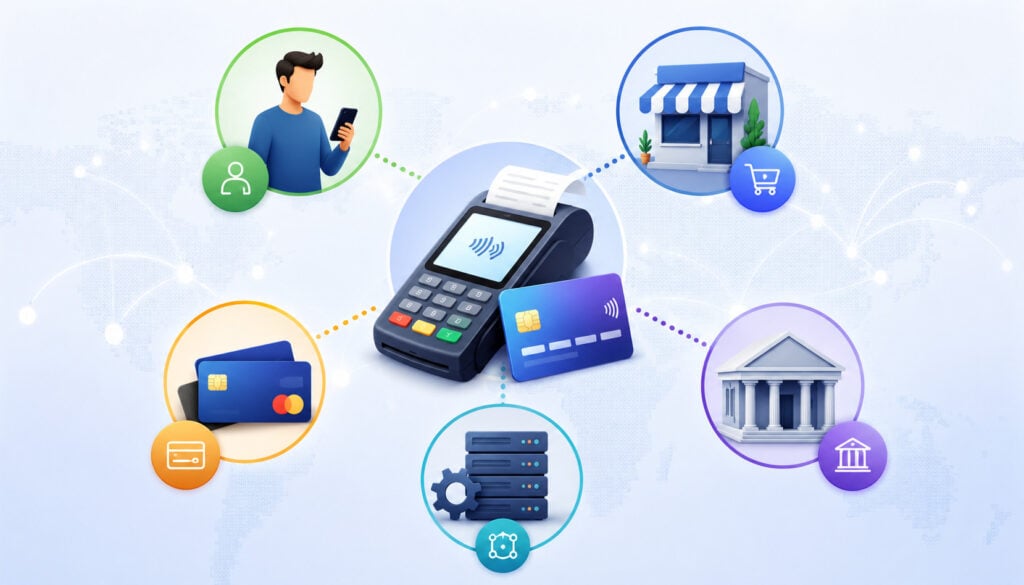
Several parties may be involved when a customer pays by card. Understanding their roles makes payment processing fees easier to interpret. A merchant statement may look complex because it reflects a system where different organizations perform different jobs.
The merchant is the business accepting payment. The merchant account is the account relationship that allows the business to accept card transactions and receive settlement deposits.
The payment processor handles transaction routing and communicates with banks and card networks. The payment gateway securely captures and sends online or keyed payment data.
The acquiring bank supports the merchant side of the transaction. The issuing bank supports the cardholder side and approves or declines the payment based on account status, available funds, fraud controls, and authorization rules. The card network provides the rules and communication rails that help connect the banks, processor, and merchant.
Each party helps make card acceptance work. That is why total payment processor fees often include more than one cost component. Some fees compensate banks for risk and funding. Some support network access and rules. Some pay for processor services, software, reporting, customer support, equipment, gateway tools, and compliance assistance.
Payment Processor, Gateway, and Merchant Account
A payment processor helps move transaction information between the business, acquiring bank, card network, and issuing bank. It supports authorization, capture, settlement, reporting, refunds, and sometimes chargeback workflows.
Without a processor, most businesses would not be able to accept card payments through a terminal, ecommerce checkout, virtual terminal, invoice, or mobile reader.
A payment gateway is especially important for ecommerce payment fees and card-not-present fees. It securely captures card data from an online checkout, invoice page, or keyed payment screen and sends it for authorization. A gateway may also support tokenization, recurring billing, AVS checks, CVV verification, fraud filters, and reporting.
A merchant account allows the business to receive funds from approved card transactions. In some setups, the merchant account, processor, and gateway are bundled. In other setups, they may be separate services with separate fees.
These differences affect how costs appear. One statement may show gateway fees, monthly fees, authorization fees, and processor markup separately. Another may bundle several costs into a single discount rate or flat-rate pricing structure.
Issuing Banks, Acquiring Banks, and Card Networks
The issuing bank provides the customer’s credit or debit card account. During authorization, the issuer decides whether the transaction should be approved. It considers available funds or credit, fraud indicators, account status, and transaction details.
The acquiring bank supports the merchant side of the payment. It helps the business access the card system, receive settlement, and manage risk. The acquirer or merchant account provider may also be involved in underwriting, funding, reserves, and account monitoring.
The card network connects the acquiring side and issuing side through rules, routing, clearing, and settlement systems. Card networks also set many standards that affect how transactions are categorized, processed, disputed, and assessed.
This is why interchange fees and assessment fees are separate from processor markup. Interchange fees generally go to the issuing bank. Assessment fees are connected to card network participation and rules. Processor markup is the portion charged by the payment processor or merchant account provider for its services.
When reviewing merchant processing fees, separating these parts helps businesses see what is pass-through cost and what may be more directly comparable among providers.
The Main Types of Payment Processing Fees
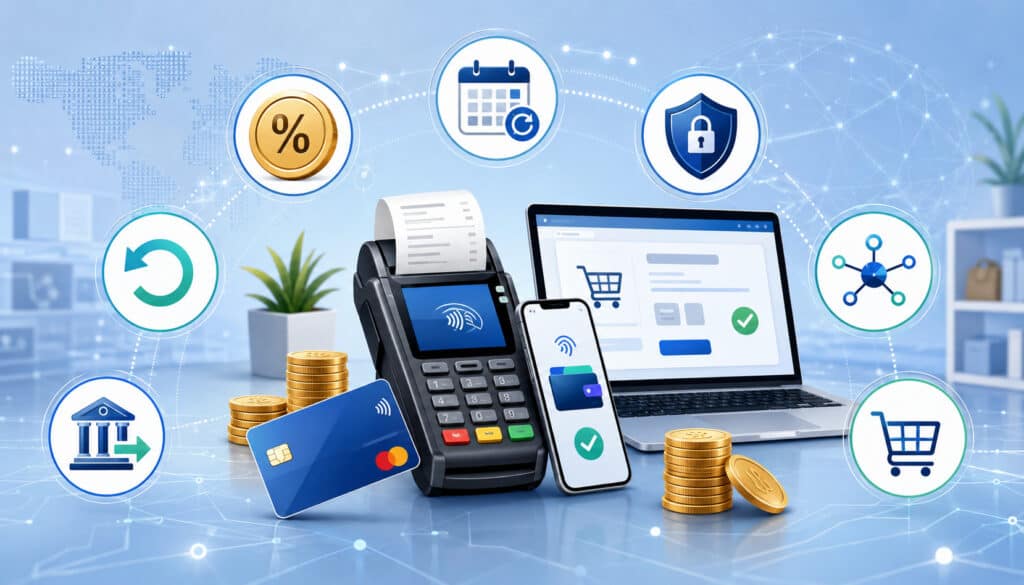
Payment processing fees can be grouped into several major categories. The most important are interchange fees, assessment fees, and processor markup. These usually form the core of credit card transaction fees and debit card processing fees.
Interchange fees are often the largest part of card processing fees. They vary by card type, transaction method, business category, risk level, and data quality. A rewards card, business card, keyed transaction, online sale, or recurring billing payment may carry a different cost than a basic debit card used in person.
Assessment fees are connected to card network rules and access. They may appear as separate line items or be bundled into a broader rate. These costs are different from interchange because they are not paid to the issuing bank.
Processor markup is the portion charged by the payment processor, gateway, or merchant account provider. Markup can appear as a percentage, per-transaction fee, monthly service fee, gateway fee, statement fee, PCI fee, batch fee, or bundled rate.
Other common merchant services fees include authorization fees, AVS fees, monthly minimum fees, PCI non-compliance fees, chargeback fees, retrieval fees, equipment fees, refund fees, early termination fees, and account setup fees.
Not every business will see all of these. A card-present retail shop may have POS payment fees and terminal-related costs. An ecommerce seller may see gateway fees, card-not-present fees, fraud tool charges, and AVS fees. A subscription company may pay recurring billing fees or tokenization-related costs.
The key is to understand what each fee means and whether it matches the agreement.
Interchange Fees Explained
Interchange fees are transaction fees paid through the payment system to the issuing bank. The issuing bank is the financial institution that issued the customer’s card. These fees compensate the issuer for its role in authorizing the transaction, handling cardholder account access, funding the purchase, and taking on certain risks.
Interchange fees are usually the largest part of credit card processing fees. They are not usually controlled directly by the payment processor, although the way a processor presents them can vary by pricing model. Under interchange-plus pricing, interchange is often shown separately. Under flat-rate pricing or tiered pricing, interchange may be blended into a broader rate.
Many factors can affect interchange fees:
- Card type, such as credit, debit, prepaid, rewards, business, or premium card
- Transaction method, such as card-present or card-not-present
- Business category and merchant category code
- Average ticket size and transaction amount
- Whether complete transaction data is submitted
- Whether the card is keyed, dipped, tapped, swiped, or entered online
- Risk level and fraud exposure
- Whether the transaction is settled on time
Card-present fees are often different from card-not-present fees because in-person payments usually provide stronger evidence that the card or payment device was present. Online payments, invoices, virtual terminals, and keyed transactions may carry higher risk because the business does not physically inspect the card.
Debit card processing fees may also differ from credit card transaction fees. Debit transactions may route through different networks, and some debit cards are subject to special rules. Premium credit cards and rewards cards often cost more because the issuer funds cardholder benefits and assumes credit risk.
Assessment Fees Explained
Assessment fees are charges connected to card network rules and access. They are separate from interchange fees because they are not paid to the issuing bank. Instead, they support the network infrastructure that enables card transactions to be authorized, cleared, settled, and governed.
Assessment fees may be based on transaction volume, transaction count, card type, cross-border activity, or specific network programs. On some merchant statements, these fees appear clearly as assessment line items. On others, they are bundled into the discount rate or included within broader payment processor fees.
Assessment fees can be easy to overlook because they are often smaller than interchange fees. However, they still affect the total cost of accepting cards. For businesses with large processing volume, even small basis-point charges can become meaningful over time.
The most important distinction is this: interchange fees are generally tied to the issuing bank, while assessment fees are tied to the card network. Processor markup is the provider’s charge for processing and account services. Separating these three parts helps a business understand the structure behind its merchant services fees.
Assessment fees may also change when network rules change or when a business adds new payment types, accepts more card-not-present transactions, or processes different types of cards. A merchant statement review should identify whether assessment fees are itemized or bundled.
Businesses do not usually negotiate assessment fees directly in the same way they may negotiate processor markup. However, they can still ask how these costs are shown, whether they are passed through at cost, and whether any additional network-related fees are included in bundled pricing.
Processor Markup Explained
Processor markup is the amount charged by the payment processor, merchant account provider, payment gateway, or related service provider above interchange fees and assessment fees. This is often the part of payment processing fees that businesses can compare most directly.
Processor markup can appear in several ways. Some providers charge a percentage markup, such as a small percentage over interchange.
Some charge a per-transaction fee. Others charge monthly fees, gateway fees, statement fees, PCI compliance fees, batch fees, account fees, or subscription pricing. In flat-rate pricing, the processor markup is usually blended into one easy-to-understand rate.
For example, a business on interchange-plus pricing may pay interchange, assessments, plus a stated processor markup. A business on flat-rate pricing may pay one fixed percentage and per-transaction fee, even though the provider is still covering interchange and assessment costs behind the scenes.
Processor markup is not automatically bad. Processors provide real services, including authorization routing, settlement, reporting, support, fraud tools, chargeback handling, payment gateway access, integrations, and payment security features.
The question is whether the markup is clearly explained, reasonable for the services provided, and consistent with the agreement.
A business should review processor markup alongside service quality. A low markup may not be helpful if the statements are confusing, support is poor, deposits are hard to reconcile, or the business lacks needed fraud tools. On the other hand, unclear markup can make it difficult to compare providers.
Common Merchant Services Fees to Know

Merchant services fees can include many line items beyond the headline processing rate. Some are routine. Some are conditional. Some are avoidable with better account management. Knowing these fees makes merchant statements easier to review.
Transaction fees are charged when a payment is processed. They may include a percentage of the sale, a fixed per-transaction amount, or both. Authorization fees are charged when a transaction is submitted for approval, even if the payment is later voided or declined in some setups.
Batch fees may apply when a business closes out the day’s transactions and sends them for settlement. Monthly fees may cover account maintenance, support, reporting, or general service access. Monthly minimum fees may apply if processing activity does not generate enough fees during the month.
Statement fees may cover the preparation or delivery of monthly merchant statements. Gateway fees apply when a payment gateway is used for ecommerce checkout, invoices, keyed payments, or recurring billing. Gateway pricing may include a monthly fee, per-transaction fee, or both.
PCI compliance fees may support tools that help businesses validate PCI compliance. PCI non-compliance fees may apply when a business fails to complete required validation or maintain compliance status. These should be taken seriously because payment security is an ongoing responsibility.
Chargeback fees apply when a cardholder disputes a transaction and the issuing bank initiates a reversal process. Retrieval fees may apply when documentation is requested before or during a dispute. AVS fees may apply when address verification is used to reduce card-not-present risk.
Equipment fees may include terminal purchases, leases, rentals, software subscriptions, or POS payment fees. Early termination fees may apply if a contract is canceled before its term ends. Account setup fees may apply during onboarding. Refund fees may apply when a transaction is returned to the customer, depending on the provider’s policy.
Payment Processing Fees Table
The table below summarizes common payment processing fees and what businesses should review. It is not a universal fee schedule. Instead, it is a practical guide to help business owners, ecommerce sellers, and finance teams understand common line items.
| Fee Type | What It Means | Who Typically Charges It | What Businesses Should Review |
| Interchange fees | Fees connected to the issuing bank’s role in the transaction | Passed through by the processor | Whether interchange is itemized or bundled |
| Assessment fees | Card network-related charges | Passed through by the processor | Whether these are shown separately |
| Processor markup | Provider charge above interchange and assessments | Payment processor or merchant account provider | Percentage markup, per-item fees, and monthly charges |
| Transaction fees | Fee charged per approved or attempted transaction | Processor or gateway | Whether charged on approvals, declines, voids, or refunds |
| Authorization fees | Fee for submitting a transaction for approval | Processor or gateway | Whether separate from transaction fees |
| Monthly fees | Ongoing account or service fee | Provider | What services are included |
| Gateway fees | Fee for online, keyed, invoice, or recurring payment access | Gateway or processor | Monthly cost, per-item cost, and features |
| PCI compliance fees | Fee related to compliance tools or validation support | Provider | What support is included |
| PCI non-compliance fees | Fee for failing to validate required compliance | Provider | How to become compliant and stop the fee |
| Chargeback fees | Fee when a disputed transaction is processed | Processor or acquiring bank | Amount, dispute workflow, and documentation support |
| Retrieval fees | Fee for document requests related to disputes | Processor or acquiring bank | Whether good records can reduce risk |
| Batch fees | Fee for closing and submitting transactions for settlement | Processor | Whether batching schedule affects cost |
| Statement fees | Fee for monthly statement access or delivery | Provider | Whether digital statements reduce cost |
| AVS fees | Fee for address verification checks | Gateway or processor | Whether AVS helps reduce fraud exposure |
| Equipment fees | Cost for terminals, POS devices, or leases | Provider or equipment vendor | Ownership, lease terms, and cancellation rules |
| Refund fees | Fee related to returning a transaction | Processor | Whether original fees are returned or retained |
A fee is not automatically unfair just because it appears on a statement. The issue is whether it is disclosed, understandable, consistent with the agreement, and appropriate for the services used.
Pricing Models for Payment Processing Fees
Payment processing fees are often presented through pricing models. The pricing model determines how interchange, assessment fees, processor markup, transaction fees, and monthly fees are shown to the business.
The most common pricing structures include flat-rate pricing, interchange-plus pricing, tiered pricing, subscription pricing, and blended pricing. Each model can work for certain businesses, but each requires careful review.
Flat-rate pricing is often easy to understand because the business pays one predictable rate for many transactions. Interchange-plus pricing is more detailed because it separates interchange, assessments, and processor markup. Tiered pricing groups transactions into categories, which can make statements harder to analyze if categories are not clearly explained.
Subscription pricing usually charges a monthly membership or platform fee plus a lower per-transaction markup. Blended pricing combines multiple cost components into a simplified rate. Blended pricing may be convenient, but it can reduce visibility into the underlying cost of different transaction types.
The best pricing model depends on business size, processing volume, transaction mix, average ticket size, sales channel, risk profile, reporting needs, and how much detail the business wants. A startup with low volume may value simplicity. A growing business with higher volume may value transparency and itemization.
Flat-Rate Pricing
Flat-rate pricing charges the same rate for broad groups of transactions. A provider might charge one rate for in-person payments and another for online or keyed payments. The main appeal is simplicity. A business can estimate costs quickly without reviewing long interchange categories.
This model may work well for newer businesses, low-volume sellers, occasional sellers, or businesses that value convenience over detailed statement analysis. It can also make forecasting easier because the rate is predictable.
However, flat-rate pricing usually blends interchange fees, assessment fees, and processor markup into one price. That means the business may not see how much of the fee went to interchange, how much went to assessments, and how much was processor markup.
The convenience may come with less cost visibility. If a business processes many low-risk card-present transactions or grows significantly, flat-rate pricing may not always remain the most cost-effective option. The only way to know is to compare total fees, not just the advertised percentage.
Interchange-Plus Pricing
Interchange-plus pricing separates the major parts of payment processing fees. The business pays actual interchange fees, assessment fees, and a stated processor markup. This structure can make it easier to understand which costs are pass-through and which costs belong to the processor.
For example, the statement may show interchange categories, assessment fees, and a markup such as a percentage plus a fixed per-transaction amount. This detail can be helpful for finance teams, higher-volume businesses, and owners who want clearer visibility into card transaction fees.
Interchange-plus pricing is often considered more transparent because it shows the underlying cost components. However, statements can be longer and more technical. Businesses must be willing to review the details or work with someone who can interpret them.
The main advantage is clarity. If costs increase, the business can better identify whether the change came from card mix, transaction method, assessment fees, chargebacks, or processor markup.
Tiered Pricing
Tiered pricing groups transactions into categories such as qualified, mid-qualified, and non-qualified. A qualified transaction receives the lowest stated tier. Mid-qualified and non-qualified transactions cost more.
This model may look simple at first because it shows a few rate categories instead of many interchange categories. However, it can be harder to evaluate because the business may not know why certain transactions were downgraded into more expensive tiers.
For example, a rewards card, keyed transaction, business card, late settlement, missing data, or card-not-present transaction may fall into a higher-cost tier. If the statement does not clearly explain how transactions are categorized, the business may struggle to identify the true cause of higher merchant processing fees.
Tiered pricing is not automatically wrong, but it requires careful review. Businesses should ask what qualifies for each tier, what causes downgrades, and how many transactions typically fall into each category.
Card-Present vs Card-Not-Present Fees
Card-present fees apply when the card or payment device is physically used at the time of sale. Examples include EMV chip payments, contactless tap payments, mobile wallet payments at a terminal, and some swipe transactions. These are common in retail, restaurants, salons, repair shops, clinics, and other in-person environments.
Card-not-present fees apply when the business does not physically capture the card at a terminal. Examples include ecommerce checkout, online invoices, phone orders, keyed transactions, virtual terminals, recurring billing, and stored-card payments.
Card-not-present fees are often higher because risk is different. The business cannot physically inspect the card, and fraud controls rely more heavily on data checks, customer authentication, AVS, CVV, tokenization, device signals, billing details, and fraud filters. Chargeback exposure can also be higher when orders are shipped, delivered later, or fulfilled digitally.
This does not mean online payments are bad. Ecommerce payment fees support convenience, reach, faster invoicing, subscription billing, and automated collections. The key is to use secure tools and understand the cost structure.
A business can manage card-not-present costs by using a secure payment gateway, enabling AVS and CVV checks where appropriate, avoiding unnecessary keyed entries, using tokenization for recurring billing, keeping clear delivery records, and documenting customer authorization.
POS payment fees may be lower for in-person transactions, but businesses should still review equipment costs, software subscriptions, batch fees, and terminal compliance. A low in-person rate can be offset by expensive leases or unnecessary add-ons.
Credit Card vs Debit Card Processing Fees
Credit card processing fees and debit card processing fees can differ because the payment products work differently. A credit card uses a credit line issued to the cardholder, while a debit card pulls funds from a deposit account. The risk, routing, network rules, and economics can vary.
Debit card processing fees may be lower in many situations, especially when PIN debit routing is available or when debit rules reduce certain costs. However, debit pricing is not always simple. Signature debit, PIN debit, regulated debit, non-regulated debit, card-present debit, and online debit can all appear differently depending on the setup.
Credit cards often cost more because the issuing bank extends credit, manages repayment risk, funds rewards programs, and supports cardholder protections. Rewards cards, premium cards, business cards, and travel cards may have higher interchange fees than basic credit cards.
For a business, the customer’s card mix matters. A company serving consumers who often use rewards credit cards may see different card processing fees than a business with many debit transactions. A business-to-business seller may see more commercial cards, purchasing cards, and higher-data requirements.
Debit cards are not always automatically cheap, and credit cards are not always automatically expensive. The transaction method, card type, business category, and pricing model all matter.
Businesses should review statement data to understand card mix. If the statement only shows one blended rate, it may be harder to see whether credit card transaction fees, debit card processing fees, or card-not-present fees are driving the total effective rate.
How Business Type Can Affect Processing Fees
Business type can affect payment processing fees because risk, transaction behavior, and card usage differ by industry. Payment systems classify merchants by business category, and that classification can influence interchange, underwriting, chargeback monitoring, reserves, and acceptable processing terms.
A retail store with small in-person transactions may have a very different cost profile than an online subscription business. A contractor collecting invoices may differ from a restaurant with tips, a medical office with recurring payments, or a marketplace with delayed fulfillment.
Several business factors can affect merchant processing fees:
- Industry and merchant category
- Average ticket size
- Monthly processing volume
- Sales channel, such as POS, ecommerce, invoices, or mobile
- Chargeback risk
- Refund frequency
- Delivery timing
- Recurring billing activity
- Card mix
- International or cross-border activity
- High-risk classification
- Use of stored cards or subscriptions
Average ticket size matters because per-transaction fees affect small-ticket businesses more heavily. A fixed fee on a small sale can represent a larger percentage of revenue than the same fee on a larger sale.
Chargeback risk also matters. Businesses with delayed delivery, travel-related services, subscriptions, digital goods, custom orders, or high refund rates may face additional scrutiny. High chargeback rates can lead to higher costs, reserves, account reviews, or even processing interruptions.
A business should avoid assuming that another company’s rate is a realistic benchmark. Two businesses can have the same monthly volume but very different card processing fees because of card mix, risk, payment method, pricing model, and service requirements.
How to Calculate Your Effective Rate
The effective rate shows the total cost of payment processing as a percentage of total card processing volume. It is one of the easiest ways to understand your overall processing cost.
Use this formula:
Total processing fees ÷ total card processing volume = effective rate
For example, suppose a business processes $80,000 in card sales during a month and pays $2,400 in total processing fees. Divide $2,400 by $80,000. The result is 0.03, or 3%.
That means the business’s effective rate for the month is 3%.
The effective rate should include all processing-related costs for the period, not just transaction fees. Include discount fees, processor markup, monthly fees, gateway fees, statement fees, PCI fees, batch fees, authorization fees, and chargeback-related fees if they appeared during that period.
Effective rate is useful because it shows the total impact of payment processing fees. It can help businesses compare month to month, identify unusual increases, and evaluate whether a pricing change actually reduced costs.
However, effective rate is not perfect. It should be reviewed alongside transaction mix, sales channel, average ticket size, card-present fees, card-not-present fees, refunds, chargebacks, debit card processing fees, and service quality.
A higher effective rate may be reasonable for a business with many small online transactions, high rewards-card usage, or recurring billing. A lower effective rate may still be costly if support is poor, reporting is weak, or hidden fees appear later.
Why Your Payment Processing Fees May Change
Payment processing fees can change for many reasons. Some changes come from your business activity. Others come from network updates, provider pricing changes, compliance status, or added services.
A shift from in-person payments to online invoices can increase card-not-present fees. A higher share of rewards cards, business cards, or premium cards can increase interchange fees. More small-ticket transactions can make fixed transaction fees more noticeable. Higher refund or chargeback activity can also increase costs.
Fees may also change if the business adds a payment gateway, virtual terminal, recurring billing tool, fraud prevention service, POS system, mobile reader, or reporting software. These services may be valuable, but they should be clearly listed and understood.
PCI non-compliance is another common reason for unexpected fees. If a business fails to complete required PCI compliance validation, a monthly non-compliance fee may appear. This fee may continue until the account is updated.
Statement changes can also create confusion. A provider may rename fees, change billing timing, separate line items differently, or adjust how pass-through costs are displayed. Businesses should compare statements carefully after any contract update, platform migration, or pricing change.
Growth can change the picture as well. Higher transaction volume may create opportunities for a different pricing model. It may also lead to new risk review requirements, reserve discussions, or more complex reconciliation.
When fees change, ask for a written explanation. The explanation should identify whether the increase came from interchange, assessments, processor markup, monthly merchant account fees, added services, PCI status, chargebacks, or transaction mix.
How Payment Processing Fees Appear on Merchant Statements
Merchant statements show how card sales, processing costs, adjustments, and deposits were handled during a billing period. They can be simple or highly detailed depending on the provider and pricing model.
A statement may include gross sales, refunds, chargebacks, processing volume, transaction count, average ticket size, deposits, discount fees, batch fees, gateway fees, monthly fees, statement fees, PCI compliance fees, and net deposits.
The discount rate may appear as the percentage charged on card volume. In some statements, the discount rate includes multiple costs. In others, interchange, assessment fees, and processor markup are shown separately. The term “discount” can be confusing because it does not mean a price reduction. It refers to the processing cost deducted from card sales.
Interchange-plus statements may show many interchange categories. These categories can identify card type, transaction method, and qualification details. Tiered statements may group sales into qualified, mid-qualified, and non-qualified categories. Flat-rate statements may show fewer details.
Net deposits can create confusion. If processing fees are deducted daily, deposits may arrive net of fees. If fees are billed monthly, deposits may be closer to gross sales, with fees deducted later. Refunds, chargebacks, reserves, and adjustments can also affect deposits.
Businesses should reconcile merchant statements with POS reports, ecommerce reports, gateway reports, accounting records, and bank deposits. If the numbers do not match, review timing differences, refunds, tips, voids, chargebacks, batch dates, and fee deductions.
Red Flags to Watch for in Processing Fees
Some payment processing fees are normal. Others deserve closer review. Red flags do not always mean something is wrong, but they should prompt questions.
Unexplained new fees are one warning sign. If a statement suddenly includes a new monthly charge, gateway fee, PCI non-compliance fee, or service fee, ask what changed and where the fee appears in the agreement.
Another red flag is unclear pricing categories. In tiered pricing, high non-qualified volume can raise costs significantly. If many transactions are falling into expensive categories, ask why. The cause may be keyed transactions, rewards cards, missing data, late settlement, card-not-present activity, or category rules.
Unexpected PCI non-compliance fees should be reviewed quickly. These fees may continue every month until compliance validation is completed. The business should ask what action is needed to restore compliance status.
Duplicate charges are another concern. A business might see both gateway fees and software fees, or multiple statement-related fees. Each charge should have a clear purpose.
Expensive equipment leases can also be costly. Some leases last longer than expected and may cost far more than buying equipment outright. Always review ownership, cancellation terms, replacement costs, and support coverage.
High chargeback fees, excessive retrieval fees, and frequent dispute-related charges may signal operational issues. Businesses should review refund policies, customer communication, delivery documentation, fraud filters, and billing descriptors.
Rates that do not match the signed agreement should be questioned. Keep copies of proposals, fee schedules, contracts, amendments, and email confirmations.
How to Reduce or Better Manage Payment Processing Costs
Businesses cannot eliminate all payment processing fees, but they can often manage costs more effectively. The first step is visibility. Review merchant statements monthly instead of only checking deposits.
Calculate your effective rate, identify the largest fee categories, and compare month-to-month changes. Look for increases in card-not-present fees, chargebacks, monthly fees, non-qualified transactions, gateway costs, or PCI non-compliance charges.
Reducing chargebacks can help control costs and protect account health. Use clear billing descriptors, accurate product descriptions, responsive customer service, documented delivery, simple refund policies, and fraud screening tools. For recurring billing, send reminders and make cancellation policies easy to understand.
Use secure payment methods whenever possible. EMV chip, contactless, secure payment links, tokenization, AVS, and CVV checks can help reduce risk. Avoid manual key entry when a better method is available.
Submit complete transaction data. Some business card, purchasing card, or invoice transactions may benefit from more detailed data when supported. Settle batches on time to avoid downgrades or unnecessary delays.
Keep PCI compliance current. If you receive a compliance questionnaire or validation request, complete it promptly. Use resources such as payment data security standards to understand why payment security matters.
Avoid unnecessary add-ons. If you are paying for software, reporting, equipment, or gateway services you no longer use, ask whether they can be removed.
Compare pricing models, not just rates. A provider with a slightly higher visible markup may still be better if statements are clearer, support is stronger, and avoidable fees are lower.
Payment Processing Fee Comparison Table
Different pricing models present payment processing fees in different ways. The right fit depends on transaction volume, business maturity, sales channel, and how much visibility the business wants.
| Pricing Model | How It Works | Potential Advantages | Important Considerations |
| Flat-rate pricing | One simple rate for broad transaction types | Easy to understand and forecast | Less visibility into interchange and processor markup |
| Interchange-plus pricing | Interchange and assessments are passed through, with stated markup | More transparent cost breakdown | Statements may be more detailed and technical |
| Tiered pricing | Transactions grouped into qualified, mid-qualified, and non-qualified tiers | Simple category structure | Harder to know why transactions fall into higher tiers |
| Subscription pricing | Monthly subscription plus lower transaction markup | Can work for steady or higher volume | Monthly fee must be justified by savings |
| Blended pricing | Multiple costs combined into one broader rate | Easier billing presentation | Can hide cost differences between transaction types |
No pricing model is best for every business. A small seller may prefer predictable flat-rate pricing. A larger business may want interchange-plus pricing for transparency. A company with stable volume may consider subscription pricing if the math works.
The most important step is comparing total costs under realistic transaction assumptions. Include volume, ticket size, card mix, online payments, in-person payments, monthly charges, gateway fees, chargeback fees, and equipment costs.
Questions to Ask Before Choosing a Payment Processor
Choosing a payment processor should involve more than asking for the lowest rate. A business should understand the full cost, statement format, support model, contract terms, and how fees may change.
Use these questions before signing or switching:
- What pricing model is used?
- Which fees are included and which are separate?
- Are interchange fees and assessment fees shown clearly?
- What processor markup is charged?
- Are there monthly fees?
- Are there monthly minimum fees?
- Are gateway fees separate?
- Are PCI compliance fees charged?
- What triggers PCI non-compliance fees?
- What are the chargeback fees and retrieval fees?
- Are authorization fees charged separately?
- Are AVS fees charged for card-not-present transactions?
- Are batch fees or statement fees charged?
- Are there equipment costs, leases, or software subscriptions?
- Who owns the terminal or POS device?
- Can rates or fees change?
- How much notice is provided before changes?
- Are there early termination fees?
- Are refund fees charged?
- How easy is it to read monthly statements?
- What support is available for reconciliation and chargebacks?
Also ask how deposits are handled. Some businesses receive net deposits after fees are deducted. Others receive deposits first and pay fees monthly. This affects reconciliation and cash flow.
If your business accepts online payments, review the payment gateway carefully. A guide to choosing a secure gateway can help frame questions about integration, fraud controls, reporting, and transaction fees.
Common Mistakes Businesses Make With Payment Processing Fees
One of the biggest mistakes is focusing only on the lowest advertised rate. A low rate may apply only to certain qualified transactions, while other transactions may cost more. Monthly fees, gateway fees, PCI fees, chargeback fees, and equipment costs can change the real cost.
Another mistake is ignoring the full fee schedule. Businesses may review the headline percentage but skip the contract details. That can lead to surprises such as monthly minimum fees, statement fees, annual fees, early termination fees, or long equipment leases.
Some businesses misunderstand pricing models. Flat-rate pricing may look more expensive on certain transactions but easier to manage. Interchange-plus pricing may look complex but provide better visibility. Tiered pricing may look simple but make downgrades harder to evaluate.
Not calculating effective rate is another common issue. Without the effective rate, a business may not know what it is truly paying across all fees.
Chargebacks are often overlooked until they become expensive. Chargeback fees, lost revenue, shipping costs, labor, and dispute documentation can add up quickly. Preventing disputes is usually easier than fighting them later.
Failing to reconcile deposits can also create accounting problems. Processing fees, refunds, chargebacks, tips, batch timing, and reserves may cause deposits to differ from sales reports.
Finally, some businesses stop reviewing statements after signing. Fees can change, new services can be added, and transaction mix can shift. Regular review is part of good financial management.
Best Practices for Reviewing Payment Processing Fees
Review payment processing fees on a schedule. Monthly review is best for most businesses because statements are issued monthly and changes are easier to spot early.
Start with total card volume, total fees, and effective rate. Then compare those numbers with prior months. Look for changes in transaction count, average ticket size, card-not-present volume, refunds, chargebacks, and monthly merchant statement fees.
Next, review line items. Identify interchange fees, assessment fees, processor markup, gateway fees, batch fees, monthly fees, PCI compliance fees, and chargeback fees. If a fee is unclear, ask for a written explanation.
Check PCI compliance status. If a PCI non-compliance fee appears, address it quickly. Resources on avoiding non-compliance fees can help businesses understand why validation and security practices matter.
Reconcile deposits against sales reports. Compare your POS, ecommerce platform, gateway dashboard, merchant statement, and bank deposits. Differences may come from refunds, chargebacks, tips, batch timing, or fee billing methods.
Track chargebacks separately. Record the reason, transaction date, amount, product or service, customer communication, evidence submitted, outcome, and any operational lesson.
Keep documentation. Save signed agreements, fee schedules, pricing amendments, equipment agreements, support emails, and monthly statements. These records are useful for accounting, contract review, and provider comparisons.
When to Get Help Understanding Processing Fees
Some businesses can review payment processing fees internally. Others may benefit from help, especially when statements are complex or costs are rising without a clear explanation.
Consider getting help if your business has large processing volume, multiple locations, several payment channels, recurring billing, high card-not-present volume, or frequent chargebacks. The more complex the setup, the more difficult it can be to evaluate merchant account fees without experience.
An accountant may help reconcile deposits, classify fees, and understand how processing costs affect financial reporting. A financial advisor may help evaluate broader cash flow and margin impact. A payment consultant or knowledgeable payment professional may help interpret statements, identify pricing model issues, and compare offers.
Help can also be useful after a pricing change, platform migration, new POS installation, or gateway change. These transitions can introduce new fees or change how costs appear.
Businesses should also seek guidance if they are unsure about compliance responsibilities, surcharge rules, contract terms, or dispute obligations. This article is educational and should not be treated as legal, tax, or financial advice.
When asking for help, provide several recent merchant statements, the signed agreement, fee schedule, processing volume, average ticket size, refund data, chargeback history, and a description of how payments are accepted.
The goal is not just to find cheaper processing. The goal is to understand total cost, reduce avoidable fees, improve reconciliation, protect cash flow, and support secure payment acceptance.
Final Thoughts on Payment Processing Fees
Payment processing fees are made up of several cost components. Interchange fees, assessment fees, processor markup, monthly fees, gateway fees, PCI compliance fees, authorization fees, batch fees, statement fees, chargeback fees, retrieval fees, AVS fees, and equipment costs can all affect the total amount a business pays.
Understanding these fees helps businesses make better decisions. It becomes easier to read merchant statements, compare pricing models, ask informed questions, and spot changes before they become expensive.
The most useful approach is balanced. Do not choose a payment setup only because it advertises the lowest rate. Also do not assume every fee is unnecessary. Payment acceptance requires secure systems, banking connections, fraud controls, compliance obligations, settlement processes, support, and reporting.
Businesses should focus on total value, transparency, and fit. A good processing setup should match the way the business sells, whether that means card-present fees through a POS system, ecommerce payment fees through a payment gateway, invoice payments, mobile payments, recurring billing, or a mix of channels.
Review statements regularly, calculate effective rate, monitor chargebacks, keep PCI compliance current, reconcile deposits, and ask for written explanations when fees change. For a deeper foundation on transaction flow, a resource on how payment processing works can help connect the fee discussion to the actual movement of payment data and funds.
The more clearly you understand payment processing fees, the easier it is to manage costs without sacrificing security, reliability, or customer convenience.
What are payment processing fees?
Payment processing fees are the costs businesses pay to accept card payments, online payments, mobile payments, invoices, and other electronic transactions. They may include interchange fees, assessment fees, processor markup, transaction fees, monthly fees, gateway fees, PCI compliance fees, chargeback fees, and other merchant services fees.
Why do businesses pay credit card processing fees?
Businesses pay credit card processing fees because card payments require authorization, fraud controls, secure data transmission, network access, issuing bank approval, acquiring bank support, settlement, reporting, and customer dispute processes. These systems make card acceptance possible and help move funds from the customer’s account to the business.
What is the average payment processing fee?
There is no single average that applies to every business. Payment processing fees depend on card type, transaction method, pricing model, business category, sales channel, chargeback risk, average ticket size, and provider terms. A business should review its own effective rate instead of relying only on broad averages.
What is the difference between interchange fees and processor markup?
Interchange fees are connected to the issuing bank’s role in the transaction. Processor markup is the amount charged by the payment processor or merchant account provider for its services. Assessment fees are separate charges connected to card network rules. Understanding these differences helps businesses compare pricing more accurately.
What are merchant services fees?
Merchant services fees are the costs related to accepting and managing electronic payments. They may include card processing fees, payment gateway fees, monthly fees, statement fees, PCI compliance fees, authorization fees, chargeback fees, retrieval fees, batch fees, equipment fees, and other account-related charges.
How do I calculate my effective rate?
Divide total processing fees by total card processing volume for the same period. For example, if total fees are $1,500 and card volume is $50,000, the effective rate is 3%. Include all processing-related fees so the calculation reflects the full cost.
Why are online payment fees higher than in-person payment fees?
Online payments are usually card-not-present transactions. The business does not physically capture the card at a terminal, so fraud and dispute risk can be higher. Payment gateways, AVS checks, CVV verification, tokenization, and fraud tools may also affect ecommerce payment fees.
Are debit card processing fees lower than credit card fees?
Debit card processing fees may be lower in many cases, but not always. Costs depend on debit routing, card type, transaction method, pricing model, and whether the transaction is PIN debit, signature debit, card-present, or card-not-present. Businesses should review actual statement data to understand their debit costs.
What are chargeback fees?
Chargeback fees are fees charged when a cardholder disputes a transaction and the issuing bank initiates a reversal process. The business may lose the sale amount and pay a chargeback fee, even if it later submits evidence. Strong records, clear policies, fraud controls, and responsive service can help reduce chargebacks.
Can payment processing fees be negotiated?
Some parts may be more negotiable than others. Interchange fees and assessment fees are generally less directly negotiable by the merchant. Processor markup, monthly fees, gateway fees, equipment costs, and certain service fees may be easier to compare or negotiate depending on volume, risk, and provider policies.
Why did my merchant processing fees increase?
Fees may increase because of changes in card mix, more online payments, higher card-not-present volume, added services, new gateway charges, increased chargebacks, PCI non-compliance, pricing updates, equipment costs, or statement changes. Review the statement line by line to identify the source of the increase.
Conclusion
Payment processing fees are not one single charge. They are a combination of interchange fees, assessment fees, processor markup, transaction fees, monthly charges, gateway fees, PCI compliance costs, chargeback-related fees, and other merchant account fees.
For business owners, ecommerce sellers, service providers, startups, and finance teams, understanding these fees is a practical advantage. It helps you review merchant statements, reconcile deposits, monitor changes, evaluate pricing models, and ask better questions before choosing or changing a payment setup.
The best approach is not to chase the lowest advertised rate without context. Look at the full cost of accepting payments, including security, support, reporting, fraud tools, settlement, contract terms, and the way your customers actually pay.
Review your statements, calculate your effective rate, keep documentation, monitor chargebacks, stay current with PCI compliance, and ask for written explanations whenever fees are unclear. With consistent review, payment processing fees become easier to understand, easier to manage, and less likely to surprise your business.