
Merchant service costs can feel confusing because they are rarely made up of one simple fee. A business may see percentages, per-item charges, monthly fees, equipment costs, compliance charges, gateway fees, chargeback fees, and several line items that use payment industry terms.
These costs matter because every card payment has a path. A customer taps, swipes, inserts, keys in, or enters card details online. Behind that payment, several parties help authorize the transaction, move data securely, settle funds, manage risk, and report activity back to the business.
For business owners, ecommerce sellers, service providers, startups, and finance teams, understanding merchant service charges is not just about finding the lowest advertised rate. It is about knowing what you are paying for, how those costs show up on a statement, and whether your payment setup matches the way your customers actually pay.
This guide explains merchant service costs in practical terms. It covers the common merchant services fees businesses may see, why they appear, how they affect total payment costs, and how to review them without getting distracted by a single headline rate.
What Are Merchant Service Costs?
Merchant service costs are the fees a business pays to accept and process card payments and related electronic payments. These payments may happen in person, online, through mobile readers, by invoice, through recurring billing, or through a point-of-sale system.
When a business accepts a credit card, debit card, contactless wallet, keyed transaction, or ecommerce payment, the payment usually needs authorization, routing, clearing, settlement, fraud screening, reporting, and support. Merchant service charges help cover the systems and parties involved in those steps.
Common costs may include payment processing fees, credit card processing fees, card processing fees, transaction fees, merchant account fees, gateway fees, batch fees, authorization fees, PCI compliance fees, equipment fees, chargeback fees, and statement fees. Not every business pays every fee, and the names may vary by provider.
A merchant account may be used to receive funds from card transactions before those funds are deposited into the business bank account. A payment gateway may securely connect an ecommerce checkout, invoice page, or virtual terminal to the payment processor. A payment processor helps move transaction data between the business, banks, and card network.
Merchant service costs can also support payment security tools, encryption, tokenization, reporting dashboards, customer support, recurring billing, mobile acceptance, and risk monitoring.
That is why two businesses with the same sales volume may have different merchant processing costs if their sales channels, transaction sizes, risk profiles, and software needs are different.
Why Merchant Service Charges Matter for Businesses
Merchant service charges directly affect profit margins. A small difference in credit card processing fees can matter for a business with tight margins, high sales volume, frequent refunds, or many low-ticket transactions. Even a small per-transaction fee can become expensive when multiplied across hundreds or thousands of monthly payments.
These costs also affect cash flow. If fees are deducted daily, deposits may not match gross sales. If fees are deducted monthly, a business may receive larger deposits but see a bigger fee withdrawal later. Settlement timing, refunds, chargebacks, reserves, and funding holds can also affect the amount and timing of cash available.
Payment costs influence pricing decisions as well. Businesses need to understand whether card processing fees are built into product pricing, service pricing, delivery fees, memberships, subscriptions, or invoice terms. Without that visibility, a business may underprice its products or misunderstand its true operating costs.
Merchant services fees are also important for reconciliation and accounting. Finance teams need to match sales reports, processor reports, deposits, refunds, chargebacks, and statement fees. If merchant statement fees are unclear, monthly reconciliation becomes more difficult.
The biggest mistake is focusing only on the lowest advertised rate. A processor may advertise a low discount rate but charge separate monthly fees, PCI non-compliance fees, gateway fees, batch fees, annual fees, or equipment fees. Another provider may advertise a higher percentage but include more services.
Key Parties Behind Merchant Services Fees
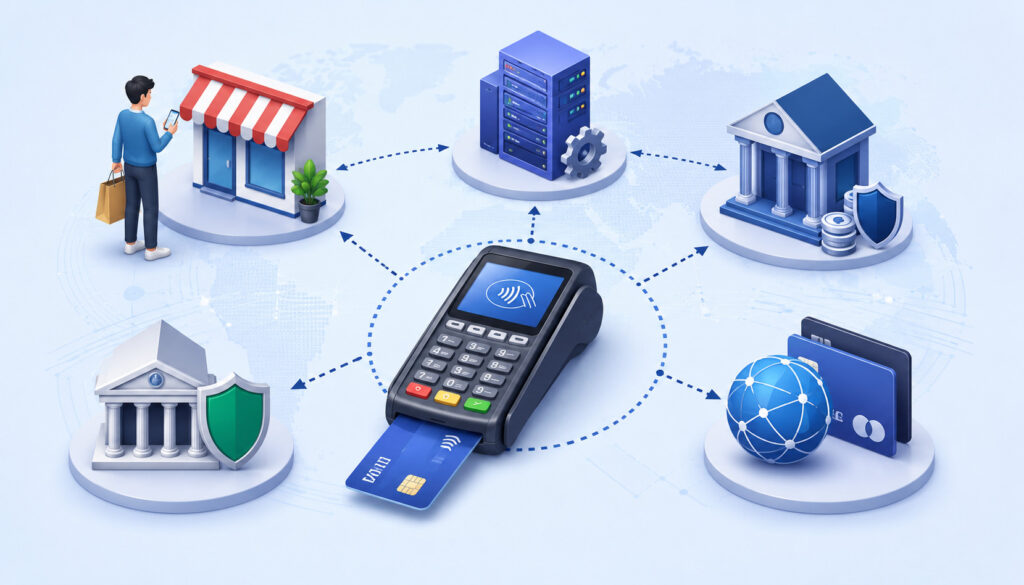
Several parties may be involved in one card transaction. Understanding who they are helps explain why merchant service costs include different layers.
The merchant is the business accepting payment. The cardholder is the customer using a credit card, debit card, or wallet connected to a card. The issuing bank is the financial institution that issued the card to the customer. The acquiring bank is connected to the merchant side of the transaction and helps with settlement.
The card network provides the rules and network rails that allow transactions to move between financial institutions. The payment processor routes transaction data and helps the business authorize, capture, settle, and report payments. A payment gateway securely transmits online or keyed payment information from an ecommerce site, invoice, or virtual terminal.
A merchant account provider may help the business set up the account used for card acceptance, underwriting, funding, reporting, and support. In some payment setups, the processor, gateway, and merchant account provider may be separate. In others, they may be bundled into one platform.
This matters because some charges are controlled by networks or issuing banks, while others are provider-controlled. Interchange fees and assessment fees are different from processor markup. Businesses that understand the difference are better prepared to read statements and ask informed questions.
Payment Processor, Gateway, and Merchant Account Provider
The payment processor helps move transaction data between the business and the wider payments system. When a customer pays, the processor helps request authorization, return an approval or decline, capture the transaction, and support settlement. It may also provide reporting, risk controls, customer support, and integrations.
The payment gateway is especially important for online payments, invoice payments, recurring billing, and virtual terminals. It securely transmits card data between the checkout environment and the processor. Businesses reviewing ecommerce payment fees should look closely at whether gateway fees are included or billed separately.
A merchant account provider helps with account setup, underwriting, funding, reporting, and merchant support. Charges connected to these services may appear as monthly fees, statement fees, payment processor fees, account maintenance fees, support fees, gateway fees, or processor markup.
Businesses comparing providers should ask which services are bundled and which are separate. A low transaction rate may not include the gateway, virtual terminal, recurring billing, next-day funding, PCI tools, or reporting features the business needs.
For more context on evaluating processor fit, this guide to choosing a payment processor can be a helpful background resource.
Issuing Banks, Acquiring Banks, and Card Networks
The issuing bank provides the card to the customer and decides whether a transaction is approved based on available credit or funds, fraud checks, account status, and cardholder rules. The acquiring bank supports the merchant side and helps move approved transaction funds toward the business.
The card network sets rules for how transactions are routed, authorized, cleared, and settled. It also sets or publishes certain fee structures and operating rules. In many cases, assessment fees are connected to the card network, while interchange fees generally flow to the issuing bank.
These charges are not the same as processor markup. Interchange fees and assessment fees are often treated as pass-through or wholesale-style components, depending on the pricing model. Processor markup is the provider-controlled part of the cost.
For debit card transactions, routing and interchange rules can be especially important. Businesses that want a deeper regulatory reference can review official materials on debit card interchange and routing rules and related electronic debit transaction rules.
Main Types of Merchant Service Costs

Merchant service costs can be grouped into several categories. Transaction-based fees are charged when a payment is authorized, captured, settled, refunded, or otherwise processed. These may include per-transaction fees, authorization fees, AVS fees, batch fees, refund fees, and debit card processing fees.
Percentage-based fees are based on the payment amount. These may include interchange fees, assessment fees, discount rate charges, and processor markup. A business with larger average ticket sizes may feel percentage fees more, while a business with many small transactions may feel fixed per-item fees more.
Monthly fees may include merchant account fees, statement fees, gateway fees, software fees, account maintenance fees, PCI compliance fees, and monthly minimum fees. These costs can apply even when sales volume is low, so they are important for seasonal businesses and startups.
Equipment and software costs may include card readers, countertop terminals, mobile readers, POS fees, software subscriptions, equipment rental, equipment fees, terminal lease fees, receipt printers, replacement costs, and maintenance charges.
Risk and dispute-related costs may include chargeback fees, retrieval fees, representment costs, reserve deductions, and funding holds. Security-related charges may include PCI compliance fees, PCI non-compliance fees, tokenization fees, fraud tools, encryption, AVS fees, and CVV-related controls.
Interchange Fees Explained
Interchange fees are a major part of many credit card processing fees. They are generally paid to the issuing bank involved in the transaction. The card network typically sets the interchange structure, but the issuing bank generally receives the interchange amount.
Interchange can vary based on many factors. Card type matters because rewards cards, commercial cards, debit cards, prepaid cards, and standard credit cards may have different cost structures.
Transaction method matters because card-present fees often differ from card-not-present fees. Business category, sales channel, transaction data quality, and risk level may also influence the category assigned to a transaction.
For example, an in-person EMV chip transaction at a retail store may qualify differently than a keyed invoice payment. An ecommerce transaction with complete AVS, CVV, and order data may price differently from a card-not-present payment with incomplete data. A rewards credit card may carry higher interchange than some debit card transactions.
Interchange fees often include a percentage and sometimes a fixed per-transaction amount. That combination means both ticket size and transaction count matter. A business processing many small credit card transaction fees may be affected by the fixed component, while a business processing large invoices may be affected more by the percentage.
Businesses can learn more about the structure of interchange fees to better understand why the lowest advertised rate rarely tells the full story.
Assessment Fees Explained
Assessment fees are different from interchange fees. While interchange generally flows to the issuing bank, assessment fees are associated with the card network. These fees help support the network infrastructure, rules, brand acceptance, data routing, and other network-level functions involved in card payments.
Assessment fees may be shown separately on a merchant statement, or they may be bundled into broader merchant service charges. Whether they are easy to see depends on the pricing model and statement format. Interchange-plus statements may show them more clearly, while flat-rate or tiered statements may combine them into broader categories.
Assessment fees are usually not the same as payment processor fees. They are not typically the part a processor can simply remove. That distinction matters when a business is trying to negotiate. A processor may have flexibility over markup, monthly service fees, statement fees, gateway charges, or equipment terms, but it may not control network assessments.
Still, businesses should review assessment-related line items. Sometimes statements include network fees, access fees, brand usage fees, or other pass-through charges. The names can vary, so the key is to ask what each charge means, who receives it, and whether it is pass-through or provider markup.
Processor Markup and Service Provider Fees
Processor markup is the portion of merchant processing fees controlled by the payment processor or service provider. It is the charge added above interchange fees, assessment fees, and other pass-through costs.
Markup may appear as a percentage, a per-transaction amount, a monthly service charge, gateway fee, statement fee, support fee, PCI-related fee, or bundled discount rate. In some pricing models, markup is easy to see. In others, it is blended into a single rate or hidden inside tiered categories.
Processor markup pays for services such as processing infrastructure, reporting tools, support, underwriting, risk monitoring, funding, integrations, account management, and sometimes gateway access. That does not mean every markup is automatically reasonable. It means businesses should evaluate the cost in relation to the value and support they receive.
Provider-controlled fees are the area where businesses often have the most room to ask questions. For example, a business may ask whether monthly fees can be reduced, whether gateway fees are included, whether batch fees apply, whether equipment can be purchased instead of leased, or whether statement fees are necessary.
A business should also ask how pricing may change. Some agreements allow fee increases, new pass-through costs, or added service charges. Written clarification is important because verbal explanations may not match future statements.
Common Merchant Account Fees
Merchant account fees are recurring or account-level charges connected to maintaining the ability to accept card payments. These fees may include monthly account fees, statement fees, monthly minimum fees, annual fees, account maintenance fees, setup fees, compliance fees, and early termination fees.
A monthly account fee may cover basic account access, support, and reporting. A statement fee may cover monthly reporting, though many businesses now receive electronic statements. A monthly minimum fee may apply if processing activity does not generate a required minimum amount of fees. This can affect seasonal businesses or new businesses with low volume.
Setup fees may be charged when opening an account, configuring a gateway, or installing software. Annual fees may appear once per billing cycle. Account maintenance fees may be described in several ways, so businesses should ask what service is being provided.
Early termination fees deserve careful attention. Some agreements renew automatically or include cancellation costs if the business leaves before the term ends. Equipment leases may also continue even after processing services end.
Transaction Fees and Authorization Fees
Transaction fees are charges tied to each payment event. They may apply to sales, authorizations, captures, refunds, voids, recurring payments, or other activity. Authorization fees are usually charged when the payment processor requests approval from the issuing bank.
These fees matter because transaction count can affect total cost as much as sales volume. A coffee shop, quick-service business, or small-ticket retailer may process hundreds of low-dollar sales.
Even a small fixed fee can meaningfully raise the effective rate. A service provider processing fewer high-ticket invoices may be less affected by fixed fees but more affected by percentage-based costs.
For retail, transaction fees may apply each time a customer taps, inserts, or swipes. For ecommerce, authorization fees may apply when a shopper checks out online.
For service businesses, keyed invoice payments may include card-not-present fees. For subscription billing, recurring transactions may generate repeated authorization fees each billing cycle.
Some statements separate authorization fees from discount fees. Others combine them into broader card processing fees. Businesses should check whether declined authorizations are billed, whether AVS fees are separate, and whether refunds create new transaction fees.
A business with many small transactions should compare the total per-item cost carefully. A slightly higher percentage with a lower fixed fee may be better for one business, while a lower percentage with a higher fixed fee may be better for another.
Gateway Fees and Online Payment Costs
Gateway fees apply when a payment gateway is used to transmit online, invoice, mobile, or keyed payment data securely. These fees are common for ecommerce stores, online booking systems, subscription businesses, donation pages, remote invoices, and businesses using a virtual terminal.
Gateway fees may include a monthly gateway charge, per-transaction gateway fee, setup fee, API fee, tokenization fee, recurring billing fee, fraud tool fee, or virtual terminal fee. Some providers bundle gateway access into the processing rate, while others bill it separately.
Online transactions often have different cost structures because they are card-not-present. The card is not physically read by an EMV terminal, so fraud risk and dispute exposure may be higher.
Security tools such as AVS, CVV checks, tokenization, encryption, fraud filters, and 3D-style authentication may help reduce risk, but some tools may add cost.
Businesses should review how ecommerce payment fees are calculated and whether the gateway integrates cleanly with their website, shopping cart, accounting system, subscription platform, or invoicing tools. Poor integration can create hidden labor costs even if the gateway rate looks attractive.
For more background, this resource on choosing a payment gateway explains gateway considerations such as security, integration, transaction fees, fraud prevention, and reporting.
Equipment, POS, and Terminal Costs
Equipment costs can include card readers, countertop terminals, mobile readers, PIN pads, receipt printers, cash drawers, barcode scanners, tablets, stands, and POS systems. Software-related POS fees may include inventory tools, employee permissions, customer profiles, reporting, online ordering, loyalty programs, and multi-location management.
Businesses may buy, rent, or lease equipment. Buying usually costs more upfront but may be less expensive over time. Renting may work for temporary or seasonal needs. Leasing can spread costs over time, but terminal lease fees may become expensive if the lease is long, non-cancelable, or separate from the processing agreement.
Replacement fees may apply if equipment is lost, damaged, or not returned. Maintenance fees may apply for support or repair. Some providers include equipment as part of a service package, while others charge separately.
POS systems can also create indirect costs. A low-cost processor may not integrate with the POS software a business needs. A powerful POS may carry monthly software fees but reduce labor, reporting errors, inventory problems, or checkout delays.
PCI Compliance and Security-Related Charges

PCI compliance relates to payment security rules designed to help protect cardholder data. Businesses that accept card payments are expected to handle payment data securely. Security responsibilities vary depending on how payments are accepted, stored, transmitted, and processed.
Common security-related charges may include PCI compliance fees, PCI non-compliance fees, data security fees, tokenization fees, encryption fees, AVS fees, fraud monitoring fees, and gateway security tool charges. Businesses can review official PCI DSS requirements to understand the framework behind payment security expectations.
A PCI compliance fee may support tools, questionnaires, scans, reporting, or account support. A PCI non-compliance fee may be charged when a business has not validated compliance or has not completed required steps. Businesses should not ignore these fees because they can recur until the issue is resolved.
Security tools also affect cost and risk. Tokenization replaces sensitive card data with a token. Encryption helps protect data during transmission. AVS checks the billing address. CVV checks help confirm that the customer has access to the card details. Fraud filters may flag unusual behavior.
Businesses should treat payment security as an operational responsibility, not just a fee. Clear access controls, secure terminals, staff training, strong passwords, updated software, and careful handling of stored payment data can reduce risk.
For additional practical context, this guide on avoiding PCI non-compliance fees may help businesses understand why ongoing validation matters.
Chargeback, Retrieval, Refund, and Dispute Fees
Chargebacks occur when a cardholder disputes a transaction through the issuing bank. The dispute may involve fraud claims, product issues, non-delivery, duplicate billing, cancellation confusion, or customer dissatisfaction. A chargeback can remove the transaction amount from the merchant while the dispute is reviewed.
Chargeback fees are separate from the original sale amount. A business may lose the sale, pay a chargeback fee, spend time gathering documentation, and still face additional risk monitoring if chargeback levels rise. Retrieval fees may apply when documentation is requested before or during a dispute.
Refund fees may apply when a business returns money to a customer. Some providers return part of the original processing cost, while others do not. Some charge a separate refund transaction fee. Reversal fees and representment costs may also appear depending on the dispute process and provider.
Documentation matters. Businesses should keep receipts, order records, delivery confirmation, signed agreements, service logs, refund policies, cancellation terms, customer communications, and proof of authorization. Clear billing descriptors can also reduce confusion.
Batch, Settlement, and Funding-Related Charges
Batching is the process of closing and submitting approved transactions for settlement. A batch fee may apply each time transactions are sent for settlement. Some businesses batch once per day, while others may batch more often depending on their system and operations.
Settlement is the process that moves funds from card transactions toward the business. Net deposits may reflect sales minus refunds, chargebacks, reserves, fees, or other adjustments. This is why bank deposits may not match gross sales exactly.
Funding-related charges may include next-day funding fees, instant funding fees, settlement fees, reserve deductions, account adjustment fees, or funding hold costs. Faster funding can help cash flow, but businesses should compare the cost against the benefit.
Reserve deductions may apply when a provider holds back a portion of funds to manage risk. This may happen for certain business models, high chargeback exposure, delayed delivery, large tickets, or unusual processing activity. Funding holds may also occur when transactions appear unusual or documentation is needed.
Businesses should review settlement reports and monthly statements together. Deposits, refunds, chargebacks, batch totals, and fees should be reconciled regularly. If deposits do not match reports, the business should ask for a written explanation.
Merchant Service Costs Table
The following table summarizes common merchant service charges and what businesses should review.
| Cost or Charge | What It Means | When It May Apply | What Businesses Should Review |
| Interchange fees | Fees generally paid to the issuing bank | Card transactions | Card type, transaction method, interchange category |
| Assessment fees | Network-level fees | Card transactions | Whether shown separately or bundled |
| Processor markup | Provider-controlled processing cost | Most pricing models | Percentage markup, per-item markup, monthly costs |
| Transaction fees | Per-payment charges | Sales, refunds, recurring billing | Cost per transaction and declined authorization billing |
| Authorization fees | Fees for approval requests | Card approvals or attempts | Whether declines and retries are billed |
| Monthly fees | Recurring account charges | Merchant account or service plan | Included services and avoidable add-ons |
| Statement fees | Charges for monthly reporting | Paper or electronic statements | Whether reports are useful and necessary |
| Gateway fees | Online payment connection fees | Ecommerce, invoices, virtual terminals | Monthly, per-item, API, and recurring billing costs |
| PCI compliance fees | Security validation charges | Card acceptance | Tools included and validation requirements |
| PCI non-compliance fees | Charges for incomplete compliance steps | Missed validation or scans | How to resolve and stop recurring charges |
| Chargeback fees | Dispute-related fees | Customer disputes | Fee amount, documentation process, prevention steps |
| Retrieval fees | Documentation request fees | Dispute inquiries | Required records and response deadlines |
| Batch fees | Fees for closing transactions | Daily settlement | Batch frequency and automation |
| Equipment fees | Hardware costs | Terminals, readers, POS devices | Buy, rent, lease, replacement terms |
| Terminal lease fees | Long-term equipment lease costs | Leased hardware | Total cost, cancellation, return terms |
| Refund fees | Fees connected to returned payments | Customer refunds | Whether original fees are returned |
| Monthly minimum fees | Minimum required fee amount | Low-volume months | Seasonal impact and calculation method |
This table is a starting point. Statement formats differ, so a business should ask for definitions of unfamiliar line items.
Pricing Models That Affect Merchant Service Costs
Pricing models determine how merchant service costs are packaged. The same underlying transaction may look very different on a statement depending on whether the business uses flat-rate pricing, interchange-plus pricing, tiered pricing, subscription pricing, blended pricing, or a surcharge-related setup.
A pricing model does not eliminate interchange fees, assessment fees, risk costs, or operational expenses. It simply changes how costs are presented and charged. That is why comparing only the advertised discount rate can be misleading.
Some businesses prefer simple pricing because it is easier to forecast. Others prefer detailed pricing because it provides visibility into interchange, assessments, and processor markup. Businesses with higher volume may benefit from more detailed statement review, while very small businesses may value simplicity.
Cash discount and surcharge-related pricing can shift some card acceptance costs to customers when structured properly and where allowed. These models require careful attention to rules, disclosure, debit restrictions, receipt language, and customer experience. Businesses should seek qualified guidance before using them.
Flat-Rate Pricing
Flat-rate pricing charges one simple percentage, often with a fixed per-transaction fee. For example, all online transactions may be charged at one rate, while in-person transactions may have another rate. The main appeal is simplicity.
This model can work well for newer businesses, low-volume sellers, mobile service providers, or businesses that want predictable costs without reviewing interchange categories. It can also be easier for budgeting because the business sees fewer statement line items.
The tradeoff is limited visibility. Flat-rate pricing may bundle interchange fees, assessment fees, processor markup, risk costs, gateway access, and other services into one rate. A business may not know whether it is paying more than necessary for lower-cost card types, debit transactions, or card-present payments.
Flat-rate pricing is not automatically bad. It may be reasonable if it includes useful software, easy setup, no long-term contract, reliable support, or simple reporting. The key is to compare the total cost against business needs.
Interchange-Plus Pricing
Interchange-plus pricing separates interchange fees, assessment fees, and processor markup. The business pays the underlying interchange and network costs plus a clearly stated markup, such as a percentage and per-transaction amount.
This model is often considered more transparent because it shows the cost layers. Businesses can see how card type, transaction method, and interchange categories affect total payment processing fees. It may also make provider markup easier to evaluate.
However, interchange-plus statements can be detailed. A business may see many interchange categories, assessment line items, authorization fees, and service charges. That detail is useful, but it requires time to review.
Interchange-plus pricing may be especially helpful for businesses with steady processing volume, varied card types, multiple sales channels, or finance teams that want cost visibility. It still requires attention to monthly fees, gateway fees, PCI fees, equipment costs, and contract terms.
Tiered Pricing
Tiered pricing groups transactions into categories such as qualified, mid-qualified, and non-qualified. A transaction may be placed into a more expensive tier based on card type, rewards card status, keyed entry, missing data, settlement timing, or other criteria.
The challenge is that tiered pricing can hide the true cost of individual transaction types. A business may see a low qualified rate but pay more when many transactions downgrade into higher tiers. This can happen with ecommerce payments, keyed transactions, rewards cards, corporate cards, or incomplete transaction data.
Tiered pricing is not always easy to compare because each provider may define tiers differently. Two providers may use the same words but classify transactions in different ways.
Businesses using tiered pricing should review how many transactions fall into each tier. Excessive non-qualified fees may signal that the pricing model, transaction setup, or data quality needs attention.
Card-Present vs Card-Not-Present Merchant Service Charges
Card-present transactions happen when the card or wallet is used in person through a terminal, reader, or POS system. EMV chip, contactless, and properly captured in-person payments may have lower risk than keyed or online payments because the cardholder and payment credential are physically present.
Card-not-present transactions happen when the card is not physically read by a terminal. Ecommerce checkout, recurring billing, invoices, phone orders, virtual terminals, and keyed payments are common examples. These transactions may carry higher card processing fees because fraud and chargeback risk can be higher.
Security data matters. AVS, CVV, tokenization, customer authentication, device data, order history, billing address, shipping address, and complete transaction details may help reduce risk. Some tools cost extra, but they may also help prevent fraud losses and disputes.
Recurring billing has its own considerations. Stored credentials should be handled securely, and customers should receive clear billing terms. Failed payment retries may create additional authorization fees. Subscription businesses should monitor cancellation processes and billing descriptors to reduce chargebacks.
Card-present businesses should train staff to use secure methods instead of keying cards when the card is available. Ecommerce businesses should review fraud settings carefully so they balance approval rates, customer experience, and risk controls.
How Business Type Can Affect Merchant Processing Costs
Merchant processing costs vary by business type because payment risk, ticket size, delivery method, sales channel, and transaction behavior vary. A restaurant, ecommerce store, medical office, contractor, subscription business, nonprofit, professional service firm, and retail shop may all have different cost patterns.
Average ticket size matters. A business with many small purchases may be sensitive to fixed transaction fees. A business with high-value invoices may be more sensitive to percentage fees and chargeback exposure.
Sales channel matters as well. In-person card-present transactions often differ from online, keyed, invoiced, or recurring payments. Ecommerce payment fees may include gateway fees, fraud tools, tokenization, and card-not-present pricing. Mobile businesses may pay for wireless readers or app-based POS tools.
Industry risk can affect underwriting and pricing. Businesses with delayed delivery, travel-related sales, future services, regulated products, subscription billing, high refund rates, or elevated chargeback exposure may face more review. Some may be classified as higher risk, which can affect fees, reserves, funding timing, and documentation requirements.
Transaction volume can also influence pricing. Higher volume may support lower markup, but it does not automatically remove interchange or assessment fees. Businesses should avoid unsupported promises and instead compare actual statements, contract terms, and service needs.
How to Calculate Your Effective Rate
Effective rate is a simple way to understand total merchant service costs as a percentage of card sales. To calculate it, divide total merchant service fees by total card processing volume for the same period.
For example, if a business processes $40,000 in card sales and pays $1,200 in total merchant services fees, the effective rate is 3%. The calculation is:
Total fees ÷ total card sales = effective rate
In this example:
$1,200 ÷ $40,000 = 0.03, or 3%
Effective rate is useful because it includes more than the advertised discount rate. It can capture transaction fees, monthly fees, gateway fees, PCI compliance fees, batch fees, statement fees, and other charges that affect total cost.
However, effective rate should not be reviewed in isolation. A business should also consider sales channel, average ticket size, transaction count, card mix, debit card processing fees, card-present fees, card-not-present fees, refunds, chargebacks, equipment costs, and software value.
A higher effective rate may be understandable for a small, low-volume, card-not-present business. A lower effective rate may be expected for a high-volume card-present business with low risk and larger ticket sizes. The goal is to compare similar situations fairly.
How Merchant Service Charges Appear on Monthly Statements
Merchant statements vary widely. Some are detailed and separate interchange, assessment fees, processor markup, monthly fees, gateway fees, and transaction fees. Others group costs into broad categories that are harder to analyze.
Common statement sections may include gross sales, refunds, chargebacks, net sales, deposits, batch totals, card type summaries, discount fees, interchange categories, assessment fees, authorization fees, AVS fees, PCI fees, statement fees, gateway fees, monthly fees, and equipment fees.
Gross sales show total processed volume before deductions. Net deposits may reflect sales minus refunds, chargebacks, reserves, fees, or adjustments. If deposits do not match sales reports, the difference may be timing, fees, refunds, or dispute activity.
Discount fees may refer to percentage-based processing charges. The discount rate may be shown as one rate or broken into components. Merchant statement fees may appear as monthly reporting or account charges.
Businesses should compare statements to POS reports, gateway reports, bank deposits, refund logs, and chargeback notices. If a line item is unclear, request a written explanation. Keep statements organized for accounting, tax preparation, contract review, and pricing analysis.
Red Flags to Watch for in Merchant Service Costs
Some merchant service charges are normal. Others deserve closer review. A red flag does not always mean something is wrong, but it does mean the business should ask questions.
Unexplained new fees are a common warning sign. These may appear as service fees, compliance fees, access fees, statement fees, monthly support fees, or miscellaneous charges. Businesses should ask when the fee started, what it covers, and whether it is optional.
Excessive non-qualified fees may indicate tiered pricing downgrades. This can happen when transactions are keyed, settled late, missing required data, or classified into expensive tiers. Ecommerce and invoice-based businesses should pay close attention.
High PCI non-compliance fees should be resolved quickly. If the business has not completed a questionnaire, scan, or validation step, the fee may recur. Duplicate charges, unexpected equipment fees, expensive leases, and unexplained monthly minimums also deserve review.
Deposit mismatches are another warning sign. If bank deposits do not match processor reports, the business should check refunds, chargebacks, reserves, batch timing, fee deduction methods, and adjustments.
How to Reduce or Better Manage Merchant Service Charges
Businesses can manage merchant service costs by improving visibility and reducing avoidable risk. Start by reviewing statements monthly. Calculate the effective rate, identify new fees, and compare transaction volume, refund activity, and chargebacks.
Keep PCI compliance current. Completing required validation steps can help avoid PCI non-compliance fees and supports stronger payment security. Train staff on secure payment handling, terminal use, refund procedures, and fraud warning signs.
Enter complete transaction data whenever possible. For card-not-present payments, AVS, CVV, accurate billing details, invoice information, and customer records can help reduce risk. For card-present payments, use chip or contactless methods instead of keyed entry when possible.
Batch transactions on time. Late settlement can sometimes affect transaction qualification or create operational delays. Reconcile deposits regularly so issues are found early.
Review equipment costs. Buying a terminal may be better than a long lease. Renting may work for short-term events. POS fees should be weighed against the operational value the software provides.
Compare pricing models based on actual processing behavior. Ask for written explanations of interchange, assessment fees, processor markup, monthly fees, gateway fees, chargeback fees, and cancellation terms. The goal is not just lower fees; it is clearer, better-managed payment acceptance.
Merchant Service Pricing Model Comparison Table
| Pricing Model | How It Works | Potential Advantages | Important Considerations |
| Flat-rate pricing | One bundled rate for many transactions | Simple, predictable, easy to understand | Less visibility into interchange and markup |
| Interchange-plus pricing | Interchange and assessments plus stated markup | More transparent, easier to analyze | Statements can be detailed and require review |
| Tiered pricing | Transactions grouped into pricing tiers | May look simple at first | Downgrades can raise total cost |
| Subscription pricing | Monthly subscription plus low markup or per-item fees | Can work for steady volume | Monthly cost may not fit low-volume businesses |
| Blended pricing | Multiple costs bundled into one rate | Easier billing presentation | Harder to identify provider-controlled fees |
| Cash discount-related pricing | Displays different pricing based on payment method | May offset card acceptance costs | Requires careful disclosure and rule review |
| Surcharge-related pricing | Adds a disclosed card-related fee where allowed | May reduce absorbed credit card costs | Rules, debit restrictions, and customer experience matter |
A pricing model should match the business’s volume, ticket size, sales channel, risk profile, reporting needs, and customer expectations.
Questions to Ask About Merchant Service Costs
Before choosing, renewing, or changing payment services, businesses should ask practical questions. These questions help reveal the full cost structure, not just the advertised rate.
Ask:
- What pricing model is used?
- Which fees are included and which are separate?
- Are interchange fees and assessment fees shown clearly?
- What processor markup applies?
- What monthly fees apply?
- Are statement fees charged?
- Are there gateway fees, virtual terminal fees, or API fees?
- Are PCI compliance fees charged?
- What triggers PCI non-compliance fees?
- What chargeback fees and retrieval fees apply?
- Are refund fees charged?
- Are there batch fees or authorization fees?
- Are AVS fees separate?
- Are there equipment fees, rental fees, or terminal lease fees?
- Can rates or fees change?
- Are there setup fees?
- Are there cancellation or early termination fees?
- How easy is the monthly statement to read?
- What support is included?
- How are deposits, reserves, and funding holds handled?
Common Mistakes Businesses Make With Merchant Service Charges
One common mistake is focusing only on the advertised rate. A low rate may not include monthly fees, gateway fees, PCI fees, batch fees, equipment fees, or chargeback costs. The true cost may be higher than expected.
Another mistake is ignoring the full fee schedule. Contracts, applications, program guides, and equipment agreements may include important charges. Businesses should read terms carefully before signing.
Some businesses do not calculate effective rate. Without this calculation, it is hard to compare total merchant processing costs from month to month. Others misunderstand pricing models and assume all rates work the same way.
Equipment costs are often overlooked. Terminal lease fees can continue for a long time, and POS fees can add up. Businesses should understand whether equipment is owned, rented, leased, or included with conditions.
Chargebacks are another area businesses may underestimate. A dispute can cost more than the original sale when fees, lost inventory, shipping, labor, and documentation time are included.
Finally, some businesses fail to reconcile deposits. Payment reports, bank deposits, refunds, and fees should be reviewed together. Without reconciliation, errors and unexpected charges can go unnoticed.
Best Practices for Reviewing Merchant Service Costs
A strong review process does not need to be complicated. Start by saving each monthly merchant statement. Compare total card sales, total fees, effective rate, refund volume, chargeback activity, and deposit timing.
Track effective rate over time. A single month may be unusual due to seasonal volume, chargebacks, or equipment charges. Trends are more useful than one isolated number.
Check for new fees. Look for unfamiliar line items, changed monthly charges, increased gateway fees, new PCI-related charges, or higher non-qualified fees. Ask for explanations in writing.
Monitor chargebacks and retrieval requests. Identify patterns by product, customer type, sales channel, billing descriptor, shipping method, or refund policy. Reducing disputes can protect both revenue and account stability.
Review PCI status regularly. Keep questionnaires, scan records, validation notices, and security documentation organized. Train staff on payment security and secure handling of cardholder data.
Reconcile deposits. Match processor reports to POS reports, gateway reports, bank deposits, refund records, and chargeback notices. If fees are deducted daily, make sure accounting entries reflect that.
Keep contracts and amendments. Store fee schedules, equipment agreements, cancellation terms, and written provider explanations. These documents help when comparing offers or resolving billing questions.
When to Get Help Understanding Merchant Services Fees
Some merchant statements are simple. Others are complex enough that professional help may be useful. A business may benefit from help when it processes large card volume, has multiple locations, accepts online and in-person payments, uses recurring billing, or has several software integrations.
An accountant may help reconcile deposits, categorize payment processor fees, track refunds, and understand how fees affect margins. A financial advisor may help with broader cash flow planning. A payment consultant or knowledgeable payment professional may help review pricing models, statement line items, equipment terms, and provider-controlled fees.
Help may also be useful when fees increase unexpectedly, chargebacks become frequent, deposits do not match reports, or a business is considering a new contract. A complex agreement may require legal review, especially if it includes long-term commitments, early termination fees, equipment leases, or surcharge-related terms.
This article is informational and should not be treated as formal legal, tax, or financial advice. When decisions affect contracts, compliance, accounting, or regulated practices, seek guidance from qualified professionals.
What are merchant service costs?
Merchant service costs are the fees businesses pay to accept and process card payments and related electronic payments. They may include transaction fees, credit card processing fees, debit card processing fees, merchant account fees, gateway fees, PCI compliance fees, equipment fees, chargeback fees, and settlement-related charges.
These costs support authorization, transaction routing, payment security, settlement, reporting, risk management, and customer support. The exact cost depends on the pricing model, sales channel, card mix, transaction volume, average ticket size, equipment, and business risk profile.
What are common merchant service charges?
Common merchant service charges include interchange fees, assessment fees, processor markup, transaction fees, authorization fees, monthly fees, statement fees, gateway fees, PCI compliance fees, PCI non-compliance fees, chargeback fees, retrieval fees, batch fees, refund fees, equipment fees, POS fees, and terminal lease fees.
Not every business pays every charge. A retail business may have equipment and POS costs, while an ecommerce seller may have gateway fees, AVS fees, and card-not-present fees. A subscription business may have recurring billing and tokenization costs.
Are merchant services fees the same as payment processing fees?
The terms are often used together, but they are not always identical. Payment processing fees usually refer to the costs of processing transactions. Merchant services fees may include processing fees plus account fees, gateway fees, equipment costs, security fees, reporting fees, and support charges.
For example, a business may pay credit card processing fees on each transaction and also pay monthly merchant account fees, PCI compliance fees, statement fees, and equipment fees. Reviewing total merchant service costs gives a more complete picture.
What are merchant account fees?
Merchant account fees are charges connected to maintaining the account used for card acceptance and settlement. They may include monthly fees, statement fees, monthly minimum fees, annual fees, account maintenance fees, setup fees, compliance fees, and early termination fees.
The names and amounts vary by provider. Businesses should ask which fees are recurring, which are conditional, which are optional, and which are connected to contract terms or equipment agreements.
What is the difference between interchange fees and processor markup?
Interchange fees are generally paid to the issuing bank and are tied to the card type, transaction method, business category, and other payment details. Processor markup is the provider-controlled fee added by the payment processor or merchant services provider.
This distinction matters because processor markup may be negotiable or structured differently, while interchange is usually treated as an underlying cost. Businesses should ask providers to separate interchange, assessments, and markup when possible.
What is an effective rate?
Effective rate is the total merchant service fees divided by total card processing volume for the same period. It shows the overall cost of accepting card payments as a percentage of sales.
For example, if a business processes $50,000 in card payments and pays $1,500 in total fees, the effective rate is 3%. This helps businesses compare total costs, but it should be reviewed alongside transaction count, card mix, sales channel, refunds, chargebacks, and service needs.
Why do merchant service charges change each month?
Merchant service charges may change because sales volume, transaction count, card types, debit and credit mix, refunds, chargebacks, card-present and card-not-present activity, gateway usage, and monthly fees change. Seasonal sales patterns can also affect the effective rate.
A business may also see new fees, annual fees, PCI non-compliance fees, equipment charges, or pricing updates. Monthly statement review helps identify whether changes are normal activity-based changes or something that requires follow-up.
Why are online payment costs different from in-person payment costs?
Online payments are usually card-not-present transactions. Because the card is not physically read by a terminal, fraud and dispute risk may be higher. That can affect interchange categories, processor pricing, gateway fees, fraud tool costs, and chargeback exposure.
Online payment costs may also include a payment gateway, virtual terminal, API access, tokenization, recurring billing tools, AVS checks, CVV checks, and ecommerce integrations. These services can add cost but may also support payment security and smoother checkout.
What are chargeback fees?
Chargeback fees are dispute-related fees charged when a cardholder disputes a transaction. A business may pay the chargeback fee even while the dispute is being reviewed. If the dispute is lost, the business may also lose the transaction amount.
Chargebacks can create additional costs through lost inventory, shipping, labor, documentation time, and account risk monitoring. Clear refund policies, accurate billing descriptors, delivery records, and responsive customer service can help reduce avoidable disputes.
Are PCI compliance fees required?
PCI compliance responsibilities apply to businesses that accept card payments, but how fees are charged depends on the provider. Some providers charge PCI compliance fees for tools, validation support, scans, or reporting. Others include those services in broader pricing.
PCI non-compliance fees may apply when a business does not complete required validation steps. Businesses should ask what is required, how to complete validation, how often it must be updated, and how to stop non-compliance charges.
Can merchant service fees be negotiated?
Some fees may be negotiable, especially processor markup, monthly fees, gateway fees, statement fees, equipment fees, and certain service charges. Interchange fees and assessment fees are usually less flexible because they are tied to issuing banks and card networks.
Negotiation is easier when a business understands its volume, average ticket size, transaction mix, chargeback history, and current effective rate. Written competing proposals and recent statements can help create a clearer comparison.
Final Thoughts on Merchant Service Costs
Merchant service costs are part of accepting modern payments, but they should not be mysterious. Businesses may pay transaction fees, interchange fees, assessment fees, processor markup, monthly fees, gateway fees, PCI-related charges, equipment fees, chargeback fees, refund fees, batch fees, and settlement-related costs.
The key is to understand what each charge means and how it fits into the full payment setup. A low advertised rate does not always mean a low total cost. A higher visible rate may include services that another provider charges separately.
Businesses should review statements, calculate effective rate, compare pricing models, monitor chargebacks, keep PCI compliance current, reconcile deposits, and ask informed questions before choosing or changing a payment setup.
The best approach is practical: know how your customers pay, understand your sales channels, review the full fee schedule, and evaluate cost alongside reliability, security, reporting, integrations, support, and cash flow.