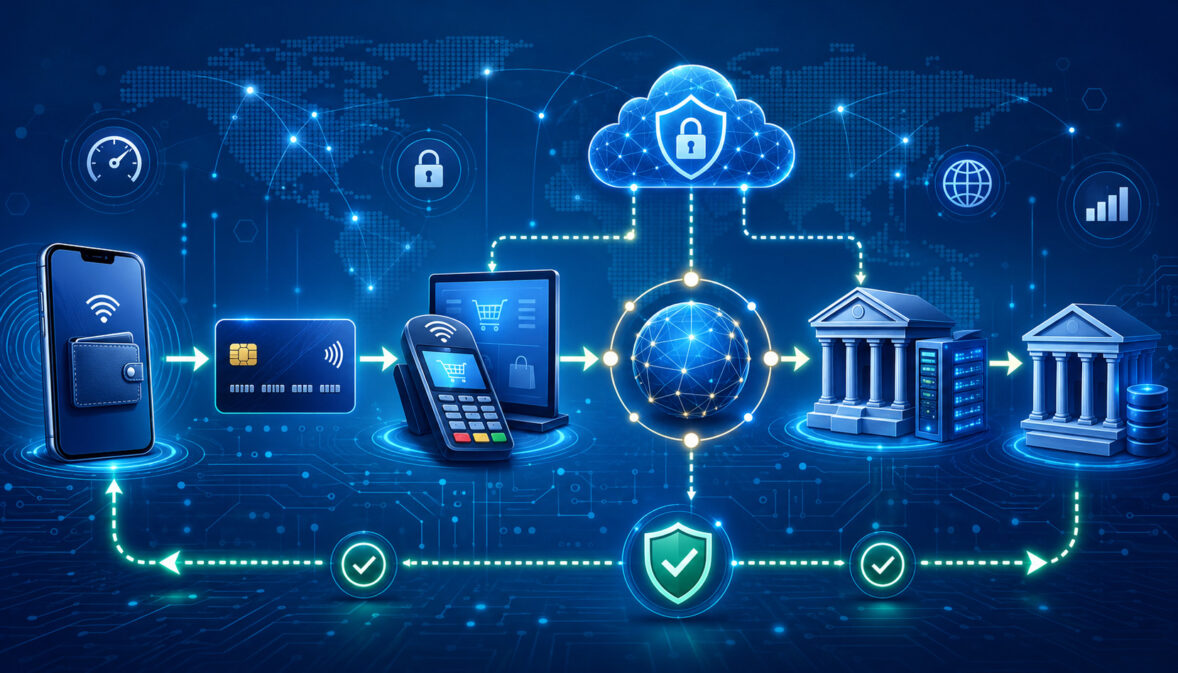
A customer taps a card, clicks a checkout button, scans a QR code, approves a wallet payment, or sends money from a bank account. To the customer, the payment may feel almost immediate.
Behind the scenes, however, the digital payment process depends on a coordinated set of systems that verify identity, protect data, route messages, approve or decline transactions, move records, calculate fees, and eventually transfer funds.
That is what it means when digital payments flow through networks. A payment is not just one message or one money movement. It is a digital transaction flow that passes through payment gateways, processors, banks, payment rails, card networks, ACH systems, real-time payment networks, fraud tools, settlement systems, and reporting platforms.
For business owners, ecommerce sellers, finance teams, service providers, and anyone accepting electronic payments, understanding how digital payments flow through networks is more than a technical curiosity.
It affects approval rates, cash flow, customer experience, payment security, chargebacks, refunds, reconciliation, and cost.
This guide explains the digital payment flow step by step. It covers card payments, ACH transfers, bank transfers, digital wallet payments, contactless payments, ecommerce payments, peer-to-peer payments, real-time payment rails, payment authorization, payment clearing, payment settlement, network fees, and the practical choices businesses face when building a reliable payment setup.
What Does It Mean When Digital Payments Flow Through Networks?
When people say digital payments flow through networks, they are describing the path payment information and funds take from the customer to the business. The customer may see a simple “approved” message, but the transaction usually travels through several connected systems before a business receives funds.
A digital payment network can include a card payment network, an ACH payment network, a real-time payment network, an electronic payment network, or a closed-loop payment platform. Each network has its own rules, message formats, security requirements, timing, risk controls, and settlement process.
For example, a credit card payment may start at an ecommerce checkout, move through a payment gateway, pass to a payment processor, route through an acquiring bank and card network, reach an issuing bank, and return with an authorization response. Later, the transaction is captured, cleared, settled, and funded.
A bank transfer follows a different path. Instead of using a card network, it may use an ACH payment network, real-time payment network, wire rail, or another account-to-account transfer system. The customer’s bank and the receiving bank exchange payment instructions, validate account details, and settle funds according to the rules of that rail.
The important point is that money rarely moves at the same moment the customer clicks “pay.” What moves first is payment data. That data is checked, encrypted, tokenized, routed, approved, recorded, and reconciled. Funds then move according to the timing of the selected payment rails.
Why Understanding Digital Payment Flow Matters
Understanding digital payment flow helps businesses make better decisions about cost, risk, cash flow, operations, and customer experience. Payment systems are not just back-office tools. They directly affect whether sales are completed, how quickly funds arrive, and how easily finance teams can match deposits to transactions.
Approval rates are one major reason to understand the digital payment process. A payment can fail because of incorrect card data, expired credentials, insufficient funds, issuer restrictions, fraud rules, gateway errors, or network routing issues.
When businesses understand where failures happen, they can improve checkout forms, use account updater tools, enable wallet options, refine fraud rules, and reduce avoidable declines.
Payment speed also matters. Some businesses need rapid access to funds for inventory, payroll, contractor payouts, or vendor obligations. Others care more about low cost and predictable reconciliation.
A card payment network may provide fast authorization, while an ACH transfer may offer a different balance of cost and timing. A real-time payment network may support immediate account-to-account movement but can carry different operational and fraud considerations.
Costs are another practical factor. Card payments may include interchange fees, assessment fees, processor markup, gateway fees, and chargeback fees.
ACH transfers may involve per-item fees, return fees, account validation costs, and administrative costs. Businesses that understand payment processing network costs can choose the right mix of payment methods instead of assuming every digital payment works the same way.
Customer experience is also tied to payment flow. A slow checkout, confusing decline message, missing wallet option, or delayed refund can frustrate customers. Reliable online payment processing makes it easier for customers to complete purchases, update payment methods, and trust the business.
Key Participants in Digital Payment Networks
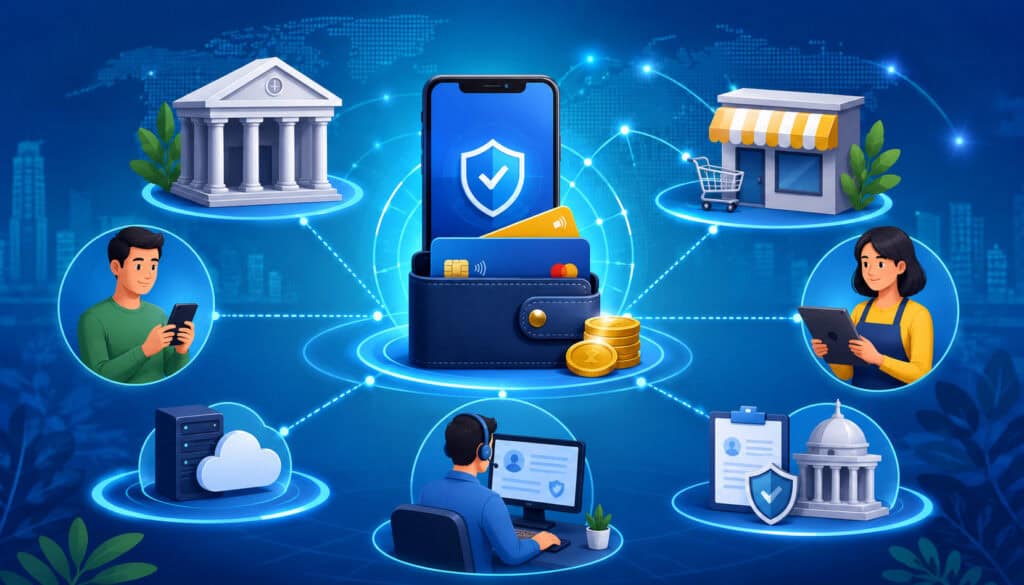
Digital payments rely on several participants. Not every transaction includes every party, but most digital payments involve a customer, a business, a payment interface, a processor or platform, one or more banks, and a payment network or rail.
The customer starts the transaction. The merchant or service provider accepts the payment. The payment gateway securely receives payment data for ecommerce payments and other card-not-present transactions.
The payment processor formats and routes payment messages to the correct network. The acquiring bank supports the merchant’s ability to accept payments and receive settlement. The issuing bank holds the customer’s card or account relationship and decides whether to approve many card-based transactions.
A merchant account is the account relationship that allows a business to accept card payments and receive settlement from card transactions. Some businesses use a direct merchant account. Others use a payment facilitator model, where the platform provides onboarding and processing under a broader structure.
A card network carries card transaction messages between acquiring and issuing sides and sets rules for authorization, clearing, settlement, disputes, interchange, and operating standards.
ACH operators help move ACH transfer records between financial institutions. Real-time payment networks support immediate or near-immediate account-to-account payment messaging and settlement functionality.
Digital wallet providers add another layer. With digital wallet payments, the wallet may store tokenized payment credentials, authenticate the customer through device-based methods, and pass a secure payment token instead of the actual card number.
Customers, Merchants, and Payment Interfaces
Customers begin digital payments through many interfaces. They may insert an EMV chip card, tap a contactless card, use a mobile wallet, enter card details online, approve a bank transfer, pay an invoice, scan a QR code, sign up for recurring billing, or send a peer-to-peer payment.
The interface matters because it shapes the data collected and the risk level of the transaction. A card-present transaction at a POS terminal can use chip or contactless technology.
An ecommerce checkout may rely on typed card details, stored credentials, wallet tokens, device data, billing address checks, and fraud screening. A recurring subscription may use a saved payment token and billing agreement instead of collecting card details every time.
Merchants submit payment data through POS systems, websites, mobile readers, payment links, invoicing tools, virtual terminals, shopping carts, or integrated software. The payment interface should collect enough information to process the transaction securely without creating unnecessary friction.
A strong payment interface helps reduce errors. Clear checkout fields, address validation, wallet options, secure hosted payment pages, and accurate invoice details can reduce failed payments and support better reconciliation.
Processors, Banks, Networks, and Payment Rails
Processors, banks, networks, and payment rails provide the infrastructure that moves payment data and funds. The payment processor receives transaction details from the merchant’s system or payment gateway, formats them according to network requirements, and routes them to the correct destination.
The acquiring bank is on the merchant side. It helps the business participate in card payment acceptance and settlement. The issuing bank is on the customer side. For card payments, the issuer checks account status, credit limit, available funds, fraud signals, and cardholder rules before approving or declining a transaction.
The payment network provides the rules and routing system. A card network routes card authorization and clearing messages. An ACH payment network moves bank account transfer records in batches. A real-time payment network supports fast payment messages and settlement between participating financial institutions.
Payment rails are the underlying routes used to move payment instructions and funds. Cards, ACH, real-time payments, wire transfers, wallet rails, and closed-loop systems are all different rails. Each rail has its own speed, cost, dispute process, refund flow, risk profile, and reporting structure.
The Basic Digital Payment Process Step by Step
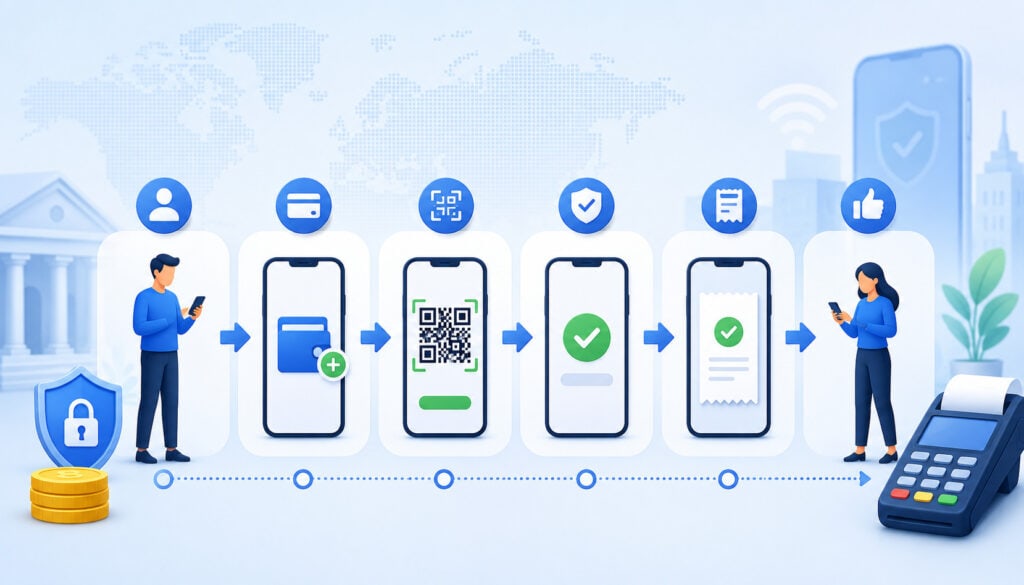
The basic digital payment process can be understood as a sequence: initiation, authentication, routing, authorization or approval, capture, clearing, settlement, funding, and post-transaction management. Some payment types use slightly different terms, but the overall pattern is similar.
First, the customer initiates the payment. They provide a card, bank account, wallet token, or other payment credential. The merchant’s system collects transaction details such as amount, merchant identifier, payment method, billing data, device data, invoice reference, or order number.
Next, security checks occur. The payment data may be encrypted, tokenized, screened for fraud, and evaluated against business rules.
For cards, this may include CVV, address verification, chip data, contactless tokenization, wallet authentication, or other risk signals. For bank transfers, it may include account validation, authorization by the account holder, and risk review.
Then transaction routing begins. The payment gateway, payment processor, bank, or platform routes the transaction through the correct payment network. The selected route depends on the payment method, merchant setup, card type, bank participation, transaction type, and network rules.
Authorization or approval follows. For card payments, the issuing bank usually decides whether to approve the transaction. For other payment types, approval may involve the sender’s bank, account validation, network acceptance, or payment confirmation. Approval does not always mean final funding has occurred.
After approval, the merchant captures the transaction. Captured transactions are submitted for payment clearing and payment settlement. Clearing creates the official records used to calculate amounts, fees, and obligations.
Settlement moves funds between financial institutions. Merchant funding deposits the net amount into the business bank account or platform balance.
Step 1: Payment Initiation
Payment initiation is the moment a customer starts the transaction. This can happen in person, online, through a mobile app, from an invoice, through recurring billing, or through a peer-to-peer payment interface.
In card-present settings, payment initiation may involve inserting a chip card, tapping a contactless card, swiping a card where permitted, or approving a mobile wallet payment near a reader. The POS terminal reads the payment credential and sends transaction data into the payment processing network.
In card-not-present settings, initiation usually happens through an ecommerce checkout, payment link, invoice portal, virtual terminal, subscription platform, or mobile app. The customer may type card details, choose a saved card, approve a wallet, or authorize a bank transfer.
Recurring payments work differently because the customer may authorize future payments in advance. The business stores a token or billing credential rather than the raw payment details. Each recurring transaction then uses that credential under the terms of the billing agreement.
Bank transfer initiation can occur when a customer enters bank account details, logs in through an account connection flow, authorizes a transfer, or schedules payment from an online banking interface. ACH transfer initiation is common for subscriptions, invoices, rent-style payments, membership dues, business-to-business payments, and payroll-style disbursements.
Peer-to-peer payments are also initiated through an app or bank interface. Although they may look simple, the underlying digital transaction flow may still rely on bank accounts, debit cards, stored balances, ACH transfers, real-time payment rails, or internal platform ledgers.
Step 2: Authentication and Security Checks
Authentication and security checks help determine whether the payment is legitimate. These checks protect the customer, the business, the financial institutions, and the network itself.
For card-present payments, EMV chip data and contactless transaction data help prove that a valid payment credential is being used at the terminal. Contactless payments and digital wallet payments often rely on tokenization, meaning the merchant receives a substitute value rather than the actual card number. This can reduce exposure if a merchant system is compromised.
For ecommerce payments, security checks may include CVV, address verification, device fingerprinting, IP analysis, email risk checks, account history, order behavior, velocity checks, and risk scoring.
A fraud screening system may compare the transaction against known patterns, such as repeated attempts, unusual order amounts, mismatched locations, or multiple cards used from the same device.
Encryption protects payment data while it moves between systems. Tokenization replaces sensitive payment information with a token that can be used for processing without exposing the original value.
PCI compliance helps businesses handle cardholder data according to recognized security standards. Readers can review general payment card data security standards through this payment card security resource.
Security checks should be strong but balanced. Overly aggressive fraud tools can block legitimate customers, while weak controls can increase chargebacks and fraud losses.
Step 3: Payment Routing Through the Network
After payment data is collected and protected, it must be routed through the right network. Transaction routing is the process of sending payment information to the correct payment rail, processor, bank, or network endpoint.
For a credit card payment or debit card payment, the payment gateway or POS system sends the transaction to the payment processor. The processor identifies the card type, merchant account, acquiring bank, and card network path. The card network then routes the authorization request to the issuing bank.
For ACH transfer transactions, the business or payment platform submits entries through an originating financial institution. Those entries move through an ACH payment network to the receiving financial institution.
The process may involve batch files, effective dates, return windows, and account validation procedures. The ACH network fact sheet gives useful background on this type of electronic payment network.
Real-time payment routing is different because participating financial institutions exchange payment messages through a real-time rail. These systems are designed for fast confirmation and account-to-account movement.
The central bank’s instant payment overview explains how instant payment infrastructure supports near real-time interbank clearing and settlement.
Routing decisions affect speed, cost, reliability, and risk. A business may use cards for ecommerce payments, ACH for recurring invoices, real-time payments for urgent payouts, and wallets for mobile checkout convenience.
Step 4: Authorization or Payment Approval
Payment authorization is the step where the relevant financial institution or network participant decides whether the transaction can move forward. For card payments, authorization usually means the issuing bank checks the account and returns an approval or decline.
The issuer may consider available funds, credit limit, card status, account restrictions, fraud patterns, merchant category, transaction location, transaction amount, and authentication results.
If the issuer approves the transaction, it sends an authorization code back through the card network, processor, gateway, and merchant system.
A declined transaction does not always mean fraud. It may happen because of insufficient funds, an expired card, incorrect card data, issuer restrictions, suspected risk, temporary network issues, or a mismatch between billing details and account records. Good decline handling can help customers retry successfully without creating duplicate charges.
For debit card payments, approval often depends on available account balance and issuer rules. For credit card payment transactions, approval depends on credit availability and risk controls.
For ACH and bank transfer payments, the approval process may involve account authorization, file acceptance, account validation, or later return handling rather than a card-style instant approval.
Pending transactions can confuse customers. A card authorization may place a temporary hold before capture and settlement. If the merchant does not capture the transaction, the hold may later fall away according to issuer rules.
Step 5: Capture, Clearing, and Settlement
Authorization is not the end of the digital payment flow. For many card transactions, the merchant must capture the approved transaction before it can be included in clearing and settlement.
Capture confirms that the merchant wants to finalize the authorized payment. In retail settings, capture may happen automatically at the time of sale or during end-of-day batch processing. In ecommerce, a business may authorize when the order is placed and capture when the item ships or the service is confirmed.
Payment clearing is the exchange of transaction records used to finalize obligations between participants. Clearing records include transaction amount, merchant details, card or account references, fee categories, timing information, and other data required by the payment network.
In card payments, clearing supports calculation of interchange fees, assessment fees, and network fees. A helpful overview of interchange fees can provide more context on one major card cost component.
Payment settlement is the movement of funds between financial institutions. For card payments, money moves from the issuing side to the acquiring side, less applicable fees and adjustments. For ACH payments, settlement follows ACH network rules and timing. For real-time payments, settlement may occur much faster through participating institutions.
The business usually receives net funding after fees, refunds, chargebacks, reserves, or adjustments. That is why the amount deposited into a merchant account or business bank account may not match gross sales exactly.
Step 6: Merchant Funding and Reconciliation
Merchant funding is when the business receives money after payment settlement. Depending on the payment method, processor, risk profile, settlement timing, weekends, holidays, reserves, and banking relationships, funds may arrive quickly or after a delay.
Card transactions may be funded to a merchant account or directly to a business bank account through a processing platform. ACH transfer funds may arrive after settlement and return risk windows, depending on the setup. Real-time payment network funds may become available faster when both financial institutions and the payment provider support the necessary flow.
Reconciliation is the process of matching payments, fees, refunds, chargebacks, deposits, invoices, and accounting records. This is where many businesses discover that payment processing is not just about accepting payments. It is also about managing accurate books.
Deposits may differ from gross sales for several reasons:
- Processor fees may be deducted before funding.
- Refunds may reduce the deposit amount.
- Chargebacks may be withheld or debited.
- Reserves may hold back a percentage of sales.
- Multiple batches may be combined into one deposit.
- A batch may settle after a weekend or holiday.
- Tips, adjustments, or delayed captures may change totals.
Strong reconciliation depends on clear reporting. Businesses should review batch reports, settlement reports, transaction IDs, refund records, and chargeback notices regularly.
Digital Payment Flow Table
The following table summarizes the main stages that occur when digital payments flow through networks. Not every payment method follows the exact same path, but most digital payments include these core functions in some form.
| Payment Stage | What Happens | Main Parties Involved | Why It Matters |
| Initiation | Customer starts the payment through a card, wallet, bank transfer, invoice, checkout, or app | Customer, merchant, POS, website, app, payment interface | Starts the digital payment process and collects transaction details |
| Authentication | Systems verify identity, credential validity, and transaction risk | Customer device, gateway, wallet, fraud tools, issuer, bank | Helps prevent fraud and reduce unauthorized payments |
| Security Protection | Payment data is encrypted, tokenized, or transmitted through secure channels | Gateway, processor, wallet provider, merchant systems | Reduces exposure of sensitive card or account data |
| Routing | Transaction data is sent through the correct payment network or rail | Gateway, processor, acquiring bank, card network, ACH operator, real-time rail | Determines speed, cost, network rules, and processing path |
| Authorization or Approval | The issuer, bank, or network participant approves or declines the transaction | Issuing bank, receiving bank, network, processor | Confirms whether the payment can proceed |
| Capture | Merchant finalizes an approved transaction for settlement | Merchant, gateway, processor, acquiring bank | Moves an authorization toward completion |
| Clearing | Transaction records are exchanged and fees are calculated | Networks, banks, processors, ACH operators | Creates official records for settlement and reporting |
| Settlement | Funds move between financial institutions | Issuing bank, acquiring bank, originating bank, receiving bank | Transfers value behind the payment |
| Funding | Business receives net funds | Processor, merchant account provider, business bank | Impacts cash flow and accounting |
| Reconciliation | Business matches deposits to sales, fees, refunds, and disputes | Merchant, finance team, accounting system, processor reports | Ensures accurate books and detects issues |
This table is useful because it separates payment messages from money movement. A customer may receive a receipt quickly, but payment settlement and funding can involve additional steps.
How Card Payments Flow Through Networks
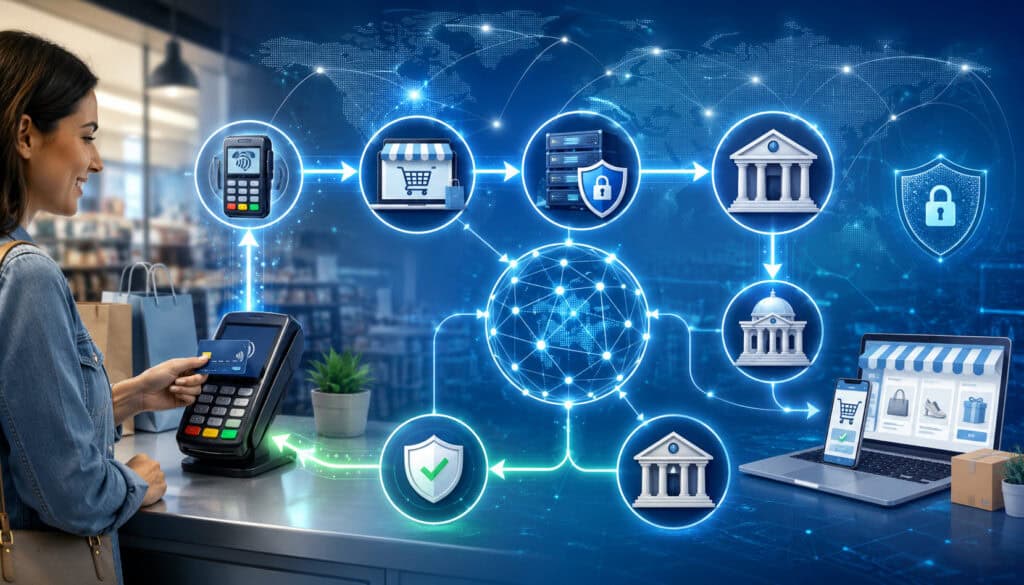
Card payments are among the most common forms of digital payments processing. A card payment network supports credit card payment and debit card payment transactions by routing messages between the merchant side and the cardholder side.
A typical card transaction begins when the customer provides card credentials. In person, this may happen through a chip card, contactless card, or mobile wallet. Online, it may happen through checkout fields, saved card tokens, or wallet approval.
The merchant’s payment gateway or POS system sends the transaction to a payment processor. The processor routes the request through the acquiring bank and card network. The card network sends the authorization request to the issuing bank. The issuer reviews the transaction and sends an approval or decline back through the same path.
If approved, the merchant can complete the sale. Later, the transaction is captured and included in a batch for clearing and settlement. During clearing, the transaction record is finalized, fees are calculated, and settlement obligations are created. During settlement, funds move from the issuing side to the acquiring side. Finally, the merchant receives funding.
Refunds and chargebacks also move through card network rules. A refund reverses money back to the cardholder after the merchant initiates it. A chargeback is a dispute process initiated by the cardholder or issuer, often involving reason codes, evidence, deadlines, and possible reversal of funds.
For more background on the mechanics, this guide to how payment processing works may be useful.
Card-Present Payment Flow
Card-present transactions happen when the customer and payment credential are physically at the point of sale. Examples include chip cards, contactless cards, mobile wallets, card readers, and POS terminals.
In an EMV chip transaction, the chip creates transaction data that helps prove the card is genuine. In a contactless transaction, the customer taps the card or mobile device near the terminal. Mobile wallet payments often use device authentication and tokenized payment credentials. The merchant does not need to manually handle the full card number.
Card-present transactions may carry different risk characteristics from card-not-present transactions because the payment credential is physically presented. Chip and contactless methods can reduce certain counterfeit card risks compared with older swipe-only methods.
The flow still includes authorization, routing, clearing, settlement, and funding. The difference is the data captured at the terminal and the security signals available to the issuer. A well-configured POS system can help reduce errors, speed checkout, support tip adjustments where relevant, and provide better batch reporting.
Card-Not-Present Payment Flow
Card-not-present transactions occur when the card is not physically used at a terminal. This includes ecommerce payments, keyed payments, invoice payments, phone payments, virtual terminal payments, subscription billing, and stored credential transactions.
Because the physical card is not present, the payment process relies more heavily on digital security checks. These may include CVV, address verification, device data, email risk, IP location, behavioral signals, tokenization, and fraud screening. Some checkout flows may also use additional authentication steps when risk is higher.
Card-not-present payments can be convenient, but they also require careful risk management. Incorrectly typed card details, expired credentials, stolen card data, friendly fraud, unclear billing descriptors, and poor refund policies can all increase decline rates or chargebacks.
Businesses accepting online payments should use secure checkout tools, clear order confirmations, accurate billing descriptors, and thoughtful fraud rules. Strong customer communication can prevent disputes that happen simply because a cardholder does not recognize a charge.
How ACH and Bank Transfer Payments Flow
ACH and bank transfer payments move money between bank accounts. They are commonly used for recurring billing, invoices, payroll-style transfers, bill payments, membership dues, vendor payments, insurance-style payments, tuition-style payments, and business payment processing.
In an ACH transfer, the party initiating the payment is often called the originator. The financial institution that submits the ACH entry is the originating bank. The receiving bank holds the account that will be debited or credited. ACH operators process and exchange entries between financial institutions.
ACH payments are usually batch-based. That means payment records are collected and processed in groups rather than one by one in real time. The transaction may be accepted into the network before the business knows for certain that the receiving account has sufficient funds or that no return will occur.
Returns are an important part of ACH payment flow. An ACH transfer can be returned for reasons such as insufficient funds, closed account, invalid account number, unauthorized debit, or administrative error. Businesses using ACH should understand return codes, authorization requirements, and account validation practices.
ACH can be useful because it often supports predictable recurring payments and bank-to-bank transfers. It may also be cost-effective for larger invoices or recurring obligations. However, settlement timing, return windows, and authorization rules require attention.
Bank transfers outside ACH may use other rails, including wire transfers or real-time payment rails. The best rail depends on speed, cost, risk tolerance, transaction size, and whether the payment needs to be reversible.
How Real-Time and Instant Payment Networks Work
Real-time payment networks are designed to move payment messages and funds much faster than batch-based systems. Instead of waiting for scheduled batch windows, participating financial institutions can exchange payment instructions and confirmations continuously.
A real-time payment network is typically account-to-account. The sender authorizes a payment from a bank account, the receiving institution receives a payment message, and the recipient may get funds quickly. These networks often provide confirmation messages, which help both sides know whether the payment was accepted.
Real-time payment rails can be useful for urgent payouts, vendor payments, insurance-style disbursements, payroll corrections, emergency refunds, same-day contractor payments, invoice payments, and certain business-to-business payments. They can also improve cash visibility because the recipient may know quickly whether funds arrived.
However, faster payments require careful fraud monitoring. Some real-time payments may be difficult or impossible to reverse once sent. That makes account validation, recipient confirmation, internal approvals, and transaction limits especially important.
Businesses should not assume real-time means risk-free. Speed changes the operational model. A mistaken payment, compromised account, or manipulated invoice can create serious problems if controls are weak.
How Digital Wallet Payments Flow
Digital wallet payments allow customers to pay using stored payment credentials on a device or in an online account. The wallet may be used in person through contactless payments or online through a checkout button.
The key feature of many digital wallet payments is tokenization. Instead of sending the actual card number to the merchant, the wallet provides a token or payment credential that represents the underlying card or account. The customer may authenticate through a device passcode, biometric check, wallet login, or other secure method.
In an in-person wallet transaction, the customer taps a device near the terminal. The terminal receives tokenized payment data and sends it through the card payment network or other applicable rail. The issuer reviews the transaction and sends an authorization response.
In an online wallet transaction, the customer may approve the payment without typing full card details. The wallet passes payment data to the merchant, gateway, or processor. The transaction may still route through a card network if the wallet is backed by a card, or through another rail if it uses a bank account or stored balance.
Digital wallet payments can reduce checkout friction and limit exposure of sensitive card data. However, businesses still need secure integration, accurate reporting, refund handling, and fraud monitoring. Wallets do not eliminate the need for payment security; they change where and how credentials are protected.
Payment Rails Explained in Simple Terms
Payment rails are the routes that payment instructions and money use to move between parties. Think of payment rails as the infrastructure beneath digital payments. Different rails are built for different purposes.
Card rails are widely used for retail, ecommerce, mobile payment process flows, subscriptions, travel-style bookings, and service payments. They provide fast authorization, broad acceptance, dispute rights, and detailed network rules. They also involve interchange fees, assessment fees, and processor costs.
ACH rails are commonly used for bank transfer payments, recurring billing, account-to-account transfers, bill payments, and business-to-business payments. ACH can be practical for predictable payments but may involve batch timing and returns.
Real-time payment rails support faster account-to-account transfers with quick confirmation. They can be valuable for urgent payments and faster cash movement, but businesses must manage fraud and finality carefully.
Wire transfer rails are often used for high-value or time-sensitive payments. They may be faster than some batch methods but can be costly and operationally strict.
Digital wallet payments are not always a separate rail. Many wallets ride on card rails or bank rails while adding tokenization, customer authentication, and a smoother interface. Closed-loop networks keep funds and transaction records inside a specific ecosystem, which can simplify some flows but limit acceptance outside that system.
The right payment rails depend on what the business needs: speed, cost control, customer convenience, lower dispute risk, recurring payment support, or stronger reconciliation.
Digital Payment Network Comparison Table
Businesses often accept more than one payment type because no single payment network is ideal for every use case. A retailer, ecommerce seller, professional service provider, subscription business, and business-to-business supplier may all prioritize different features.
| Payment Network or Rail | Common Use Cases | Typical Speed | Key Considerations |
| Card payment network | Retail sales, ecommerce payments, subscriptions, invoices, mobile payments | Fast authorization; funding depends on processor and settlement setup | Broad acceptance, chargebacks, interchange fees, assessment fees, fraud rules |
| ACH payment network | Recurring billing, bank transfer payments, invoices, payroll-style payments, vendor payments | Often batch-based; timing varies by setup | Lower per-transaction cost in many cases, return risk, authorization requirements |
| Real-time payment network | Urgent payouts, account-to-account transfers, invoice payments, vendor payments | Designed for rapid confirmation and faster settlement | Strong controls needed because payments may be difficult to reverse |
| Wire transfer rail | High-value or time-sensitive transfers | Often fast once initiated and accepted | Higher cost, strict instructions, limited reversal options |
| Digital wallet payments | Contactless payments, online checkout, mobile app payments | Often fast at checkout; settlement depends on underlying rail | Tokenization, device authentication, customer convenience |
| Closed-loop network | Stored balance payments, marketplace credits, gift-style balances, platform payments | Varies by platform rules | Limited acceptance, platform-specific rules, internal ledger controls |
The most reliable setup often combines payment methods. Cards may work best for customer convenience. ACH may work well for recurring invoices. Real-time payments may fit urgent disbursements. Wallets may improve mobile checkout completion.
Fees Connected to Digital Payment Networks
Digital payment networks involve costs because many parties support the transaction flow. The fee structure depends on the payment method, merchant category, transaction type, risk profile, processing setup, and provider agreement.
For card payments, interchange fees are paid to the issuing side and vary based on factors such as card type, transaction environment, merchant category, and risk. Assessment fees are charged by the card network. Processor markup may include a percentage, per-transaction fee, monthly fee, gateway fee, statement fee, batch fee, or other pricing component.
Gateway fees may apply to online payment processing, payment links, virtual terminals, recurring billing tools, or API-based payment flows. Chargeback fees may apply when a cardholder disputes a transaction. Refunds may or may not return original processing fees depending on the provider and network rules.
ACH fees are often structured as flat per-item costs, percentage fees, monthly fees, account validation costs, return fees, or same-day processing fees. Bank transfer payments can also involve administrative costs, especially when handling returns or customer authorization.
Real-time payment fees vary by provider and financial institution. Wire transfers may involve sending and receiving fees. Digital wallet payments may carry costs tied to the underlying card or bank rail.
The lowest visible transaction fee is not always the lowest total cost. Businesses should also consider approval rates, fraud losses, dispute rates, settlement timing, reporting quality, support, and integration effort.
Security and Compliance in Digital Payment Networks
Payment security protects sensitive customer data and helps maintain trust in digital payments. Security must be built into the full digital transaction flow, not added only at checkout.
Encryption protects data while it is transmitted or stored. Tokenization replaces sensitive payment credentials with substitute values. Secure APIs help systems communicate safely. Access controls limit who can view or modify payment data. Logging and monitoring help detect unusual activity.
PCI compliance is especially important for businesses that accept card payments. The scope of compliance depends on how payment data is handled.
A business using a hosted payment page may have a different security burden from one storing or transmitting cardholder data directly. Even when a provider handles much of the technical work, the business still needs secure practices, staff training, and proper configuration.
Fraud monitoring is another critical layer. Risk tools may evaluate transaction amount, device behavior, account history, billing data, shipping data, velocity, and previous disputes. These tools can reduce losses, but they should be tuned carefully to avoid blocking legitimate customers.
Chargeback prevention is also part of payment security. Clear billing descriptors, accurate product descriptions, delivery proof, responsive customer support, and fair refund policies can reduce disputes. Security is not only about technology; it is also about operational clarity.
Businesses should keep payment systems updated, review user permissions, monitor failed login attempts, and avoid storing sensitive data unless necessary.
What Can Go Wrong During Digital Payment Flow?
Digital payments are reliable when systems are configured well, but problems can still occur. A payment may fail during initiation, authentication, routing, authorization, capture, settlement, funding, refunding, or reconciliation.
Common issues include declined transactions, duplicate payments, gateway timeouts, expired cards, insufficient funds, invalid account numbers, ACH returns, fraud flags, network outages, delayed settlement, batch upload errors, chargebacks, refund delays, payment reversals, mismatched deposits, and missing transaction references.
Some problems are customer-facing. A checkout page may show a decline or error. A customer may retry and accidentally create multiple authorizations. A saved card may fail because it expired. A digital wallet may fail because device authentication did not complete.
Other problems appear later. A card payment may be approved but not captured. An ACH transfer may be returned after the business thought it was complete. A batch may settle later than expected. Fees, refunds, and reserves may make deposits look incorrect.
Businesses should track where payment failures occur. Gateway logs, processor reports, decline codes, ACH return codes, chargeback reports, and settlement files can reveal patterns. The goal is not to eliminate every issue, but to reduce preventable failures and respond quickly when exceptions occur.
Authorization and Routing Problems
Authorization and routing problems happen before the payment is fully accepted. They can be caused by incorrect card data, expired cards, insufficient funds, issuer restrictions, blocked merchant categories, suspected fraud, network downtime, gateway configuration issues, or processor routing errors.
In ecommerce payments, small form problems can create big decline rates. Missing billing fields, unclear error messages, poor mobile checkout design, and address formatting problems can lead to failed transactions. In card-present settings, terminal connectivity, outdated software, damaged cards, or fallback processing can create friction.
Risk rules can also reject valid customers. For example, a strict velocity rule may block a legitimate customer placing multiple orders. A location mismatch may flag a traveler. A large invoice may look unusual even when it is valid.
Businesses should review decline codes carefully. Some declines are hard declines, meaning the same payment method should not be retried. Others are soft declines, meaning the customer may succeed after updating information, using another method, or completing additional verification.
Settlement, Funding, and Reconciliation Problems
Some payment problems appear after authorization. A transaction may be approved, but if it is not captured, it may not settle. A batch may fail because of formatting issues, late submission, duplicate records, or processor errors. A deposit may be delayed because of weekends, holidays, risk review, reserve requirements, or bank processing schedules.
Funding issues can also occur when refunds, chargebacks, or fees are deducted from settlement. A business may see a deposit that does not match the day’s gross sales and assume something is missing. In reality, the difference may come from discount fees, batch timing, prior refunds, disputes, or rolling reserves.
ACH payments add another layer because returns can occur after initial acceptance. A payment may later be returned for insufficient funds, closed account, invalid account number, or authorization issues. This can create accounting complications if the business provides goods or services before the payment is fully settled.
Strong reconciliation practices reduce confusion. Businesses should match transaction reports to batch reports, batch reports to deposits, and deposits to accounting entries.
Best Practices for Businesses Accepting Digital Payments
Businesses can improve payment reliability by treating payment operations as an ongoing process. The best setup is not only the one that accepts the most payment methods. It is the one that balances customer convenience, cost, security, risk, reporting, and cash flow.
Start by choosing payment methods that fit the business model. Ecommerce sellers may need cards, digital wallet payments, and secure checkout tools. Service providers may need invoices, cards, ACH transfers, and recurring billing. Business-to-business sellers may need ACH, cards, real-time payouts, or bank transfer options.
Use secure payment tools. Hosted checkout pages, tokenization, encryption, role-based access, and properly configured fraud screening can reduce risk. Keep software, terminals, plugins, and integrations updated.
Review reports regularly. Payment reports should show authorizations, captures, refunds, chargebacks, fees, deposits, and settlement timing. Finance teams should reconcile deposits consistently and investigate unusual gaps quickly.
Train staff who handle payments. Staff should know how to process refunds, avoid duplicate charges, recognize suspicious behavior, explain pending authorizations, and escalate settlement issues. Clear internal procedures reduce mistakes.
Set clear customer-facing policies. Refund timelines, cancellation rules, subscription terms, billing descriptors, and customer support contact details can reduce disputes. Many chargebacks begin with confusion rather than intentional fraud.
For additional background, this resource on how payment gateways work can help businesses understand the gateway layer.
How to Choose the Right Digital Payment Network or Setup
Choosing the right payment setup starts with the business model. A high-volume retailer, a subscription company, a professional services firm, a marketplace, and a wholesale supplier may all need different payment flows.
Consider transaction volume and average ticket size. Card fees may be manageable for smaller purchases but significant on large invoices. ACH may be useful for larger recurring payments, while cards may provide better customer convenience and faster authorization.
Sales channel matters. In-person businesses need reliable POS systems, chip support, contactless payments, and clear batch reporting.
Ecommerce businesses need secure checkout, payment gateway integration, fraud screening, wallet support, and strong order management. Mobile businesses need portable readers, app-based reporting, and connectivity planning.
Customer preferences also matter. Some customers prefer cards for rewards or dispute rights. Others prefer bank transfer for invoices. Mobile-first customers may prefer digital wallet payments. Business customers may prefer ACH transfer or bank transfer options for larger invoices.
Review settlement timing and cash flow needs. A business with tight cash flow may value faster funding. A business with larger invoices may prioritize lower costs and stronger account validation. A business with high dispute exposure may need better fraud tools and documentation workflows.
Integration quality is important. The payment system should work with ecommerce platforms, accounting software, invoicing tools, customer databases, inventory systems, and reporting dashboards. Poor integration creates manual work and reconciliation errors.
Contract terms, support quality, pricing transparency, scalability, chargeback tools, and security responsibilities should all be reviewed. A guide to choosing a payment processor can help frame these decisions.
Final Thoughts on How Digital Payments Flow Through Networks
Understanding how digital payments flow through networks helps businesses see what really happens after a customer pays. A digital payment is not just a swipe, tap, click, or transfer.
It is a connected sequence of initiation, authentication, security checks, transaction routing, payment authorization, capture, payment clearing, payment settlement, merchant funding, and reconciliation.
Each payment network has strengths and trade-offs. Card networks offer broad acceptance and fast authorization but include interchange fees, assessment fees, chargebacks, and network rules. ACH networks can support recurring bank transfer payments but involve timing and return considerations.
Real-time payment networks can move funds faster but require strong fraud controls and careful payment approval workflows. Digital wallet payments can improve checkout speed and security by using tokenization and device authentication.
Businesses that understand the digital payment flow can make better choices. They can improve approval rates, reduce failed payments, manage payment security, lower avoidable disputes, forecast cash flow, compare fees more accurately, and choose payment rails that fit their operations.
The goal is not to memorize every technical detail. The goal is to understand the path well enough to ask better questions, read payment reports with confidence, and build a payment process that is secure, reliable, cost-aware, and customer-friendly.
What does digital payment flow mean?
Digital payment flow means the sequence of steps a payment follows from the moment a customer starts a transaction to the moment the business receives and reconciles funds.
It includes payment initiation, authentication, security checks, transaction routing, authorization or approval, capture, payment clearing, payment settlement, funding, refunds, chargebacks, and reporting.
The exact flow depends on the payment method. A card payment may move through a gateway, processor, acquiring bank, card network, and issuing bank. An ACH transfer moves through bank account rails.
A real-time payment may move through a faster account-to-account network. The phrase helps describe both the movement of payment data and the later movement of money.
How do digital payments flow through networks?
Digital payments flow through networks by sending secure payment messages between the customer’s payment source, the merchant’s payment system, banks, processors, and payment rails.
First, the customer provides payment credentials. Then the merchant’s system sends the payment data to a gateway or processor.
The transaction is authenticated, screened for fraud, encrypted, tokenized where applicable, and routed through the correct payment network. For card payments, an issuing bank approves or declines the transaction.
For bank transfers, the transaction may be accepted, validated, settled, or later returned according to rail rules. After approval, clearing and settlement records move funds between institutions, and the business receives funding.
What is a digital payment network?
A digital payment network is a system that helps move payment information and value between parties electronically. It can include a card network, ACH network, real-time payment network, wire rail, digital wallet structure, or platform-based payment system.
A payment network sets rules for message formatting, routing, risk management, dispute handling, settlement timing, fees, and participant responsibilities. Without these networks, customers and businesses would not have a standardized way to exchange payment instructions across banks, cards, apps, and platforms.
What parties are involved in digital payments processing?
Common parties include the customer, merchant, payment gateway, payment processor, acquiring bank, issuing bank, card network, ACH operator, real-time payment network, wallet provider, merchant account provider, and payment facilitator.
Not every payment includes every party. A card-not-present ecommerce payment may involve a gateway, processor, acquiring bank, card network, and issuing bank.
An ACH payment involves bank account authorization, an originating financial institution, ACH operators, and a receiving financial institution. A wallet payment may add device authentication and tokenized credentials.
How are card payments different from ACH payments?
Card payments usually provide fast authorization through a card payment network. The issuing bank approves or declines the transaction, and the merchant later captures the payment for clearing and settlement.
Card payments are widely accepted and convenient, but they can involve interchange fees, assessment fees, chargebacks, and card network rules.
ACH payments move money between bank accounts through an ACH payment network. They are often used for recurring payments, invoices, bill payments, and business-to-business transfers.
ACH may be cost-effective, but it can involve batch timing, returns, account validation needs, and authorization requirements.
What is the role of a payment gateway?
A payment gateway securely collects and transmits payment data, especially for online payment processing. It connects a merchant’s checkout, invoice page, app, or virtual terminal to the payment processor or acquiring side.
The gateway may support encryption, tokenization, fraud tools, recurring billing, payment forms, wallet acceptance, and transaction reporting. In ecommerce payments, the gateway is often the secure bridge between the customer-facing checkout and the payment processing network.
What is the role of a payment processor?
A payment processor handles the technical routing and processing of transaction messages. It receives payment data from the gateway, POS system, software platform, or merchant system and sends it to the correct network or bank.
The processor may support authorization, capture, batch submission, settlement reporting, refunds, chargeback tools, and merchant funding. In many payment setups, the processor is the operational hub that helps digital payments flow through networks reliably.
How long does digital payment settlement take?
Settlement timing depends on the payment method, provider, network rules, bank schedule, risk profile, and transaction timing. Card payments may authorize quickly, but merchant funding depends on capture, batch processing, settlement, and the processor’s deposit schedule.
ACH transfers may take longer because they often use batch processing and can involve return windows. Real-time payment networks are designed for faster account-to-account movement, but availability depends on participating institutions and provider support. Weekends, holidays, reserves, risk reviews, and batch cutoffs can also affect funding.
Why do some digital payments fail?
Digital payments can fail for many reasons. Common causes include incorrect card data, expired cards, insufficient funds, issuer restrictions, account holds, closed bank accounts, invalid account numbers, failed authentication, fraud flags, velocity rules, network outages, gateway errors, and processor configuration problems.
A payment may also appear successful at first and fail later. For example, an ACH transfer may be returned after initial acceptance. A card authorization may not settle if it is not captured. Businesses should review decline codes, return codes, and settlement reports to understand the exact cause.
Conclusion
Digital payments flow through networks using several connected stages. A customer starts the payment, systems authenticate and protect the data, the transaction is routed through the correct payment network, authorization or approval occurs, and the transaction moves through capture, clearing, settlement, merchant funding, and reconciliation.
Behind every credit card payment, debit card payment, ACH transfer, bank transfer, digital wallet payment, contactless payment, ecommerce payment, mobile payment process, or real-time payment is a structured digital payment network.
These networks make electronic payments possible by connecting customers, businesses, processors, gateways, acquiring banks, issuing banks, financial institutions, and payment rails.
For businesses, understanding the flow helps with practical decisions. It can improve approval rates, reduce avoidable declines, strengthen payment security, manage chargebacks, control fees, forecast cash flow, and simplify reconciliation.